


Page 380 - Sustainable On-Site CHP Systems Design, Construction, and Operations
P. 380
Optimal Sizing Using Computer Simulations—New School         353


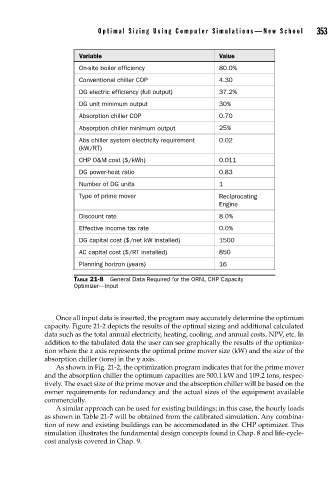
                       Variable                               Value
                       On-site boiler efficiency              80.0%
                       Conventional chiller COP               4.30
                       DG electric efficiency (full output)   37.2%
                       DG unit minimum output                 30%
                       Absorption chiller COP                 0.70
                       Absorption chiller minimum output      25%
                       Abs chiller system electricity requirement   0.02
                       (kW/RT)
                       CHP O&M cost ($/kWh)                   0.011
                       DG power-heat ratio                    0.83
                       Number of DG units                     1
                       Type of prime mover                    Reciprocating
                                                              Engine

                       Discount rate                          8.0%
                       Effective income tax rate              0.0%
                       DG capital cost ($/net kW installed)   1500
                       AC capital cost ($/RT installed)       850
                       Planning horizon (years)               16

                     TABLE 21-8  General Data Required for the ORNL CHP Capacity
                     Optimizer—Input


                Once all input data is inserted, the program may accurately determine the optimum
             capacity. Figure 21-2 depicts the results of the optimal sizing and additional calculated
             data such as the total annual electricity, heating, cooling, and annual costs, NPV, etc. In
             addition to the tabulated data the user can see graphically the results of the optimiza-
             tion where the x axis represents the optimal prime mover size (kW) and the size of the
             absorption chiller (tons) in the y axis.
                As shown in Fig. 21-2, the optimization program indicates that for the prime mover
             and the absorption chiller the optimum capacities are 500.1 kW and 109.2 tons, respec-
             tively. The exact size of the prime mover and the absorption chiller will be based on the
             owner requirements for redundancy and the actual sizes of the equipment available
             commercially.
                A similar approach can be used for existing buildings; in this case, the hourly loads
             as shown in Table 21-7 will be obtained from the calibrated simulation. Any combina-
             tion of new and existing buildings can be accommodated in the CHP optimizer. This
             simulation illustrates the fundamental design concepts found in Chap. 8 and life-cycle-
             cost analysis covered in Chap. 9.

