


Page 391 - Sustainable On-Site CHP Systems Design, Construction, and Operations
P. 391
364    Ca s e  S t u d y 4


                or
                            (Revenue 1 − Revenue 2) = (Expense 1 − Expense 2)

                It should be noted that
                 •  The fixed costs are the same in Expense 1 and Expense 2.
                 •  The revenues from campus steam are the same in Revenue 1 and Revenue 2.
                 •  The revenues from chilled water are the same in Revenue 1 and Revenue 2.
                When the revenues and expenses are subtracted as shown, the net result for fixed
             costs, steam revenues, and chilled water revenues are all equal to zero. This shows that
             the break-even point is not dependent on the cost of the fixed maintenance charges, nor
             on the steam or chilled water purchase cost from the CUP to the campus and thus can
             be ignored for the purposes of this analysis.
                In Tables 22-9 and 22-10, the unknown variable is “campus steam”. Solving the
             equation for the break-even point between the absorber (1) and turbine exhaust duct
             burner (2) modes with the natural gas and electric rates noted in this study, results in a
             campus steam load of 29,415 lb/h. Accordingly, should the campus steam load exceed
             this value, it is more economical to run both cogeneration units and dump steam to the
             absorber. For campus loads below 29,415 lb/h, it is more economical to run one cogen-
             eration unit with its turbine exhaust duct burner.

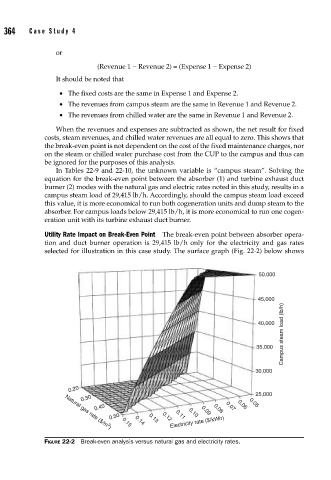
             Utility Rate Impact on Break-Even Point  The break-even point between absorber opera-
             tion and duct burner operation is 29,415 lb/h only for the electricity and gas rates
             selected for illustration in this case study. The surface graph (Fig. 22-2) below shows


                                                                         50,000


                                                                         45,000
                                                                                Campus steam load (lb/h)

                                                                         40,000


                                                                        35,000


                                                                        30,000
                    0.20
                                                                        25,000
                        0.30                                          0.05
                           0.40                          0.09  0.08  0.07  0.06
                               0.50       0.13  0.12  0.11  0.10
                                                Electricity rate ($/kWh)
                                       0.14
                               3
                                   0.15
                   Natural gas rate ($/m )
             FIGURE 22-2  Break-even analysis versus natural gas and electricity rates.

