


Page 114 - The CNN Effect in Action - How the News Media Pushed the West toward War ini Kosovo
P. 114
1403975191ts06.qxd  21-2-07  06:29 PM  Page 88
                                                         88
                                                                THE CNN EFFECT IN ACTION
                                                         stiff resistance from the KLA. To Serbs, Racak was not a massacre,
                                                         but an attempt by the KLA, who had retaken the town after the
                                                         Serb’s departure, to frame a massacre scene and create international
                                                         outrage. What the world saw the following day involved the gathering
                                                         of fallen KLA fighters from the day’s battle, subsequently dressed in
                                                         civilian clothing and placed in a fashion that depicted a massacre.
                                                         According to Serbian accounts, this was done at night so that, by the
                                                         next morning, international journalists and monitors could record
                                                         the event as an atrocity, not a battle.
                                                         offended with the behavior and comments of William Walker, who
                                                         they believed showed bias toward the Albanian side by making
                                                         judgments on the incident without a full investigation. Two weeks
                                                         after the incident, Serbian authorities believed that they were vindi-
                                                         cated by a forensic team’s investigation that concluded that the dead
                                                         from Racak were shot from a distance and had evidence of gunpowder
                                                         on their hands. The West, however, largely dismissed the forensic
                                                         team’s findings as biased due to the Yugoslav and Belorussian com-
                                                         position of the team. This conclusion was further refuted several
                                                         months later when an EU-sponsored forensic team that had access
                                                         to the same corpses referred to the incident as a crime against
                                                         humanity. 49                    48  The Serbs were particularly
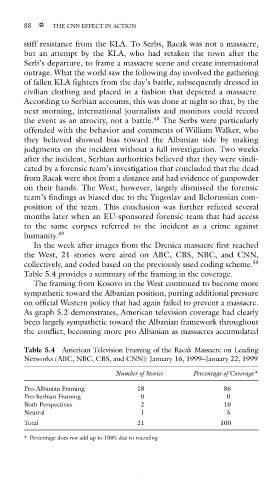
                                                           In the week after images from the Drenica massacre first reached
                                                         the West, 21 stories were aired on ABC, CBS, NBC, and CNN,
                                                         collectively, and coded based on the previously used coding scheme. 50
                                                         Table 5.4 provides a summary of the framing in the coverage.
                                                           The framing from Kosovo in the West continued to become more
                                                         sympathetic toward the Albanian position, putting additional pressure
                                                         on official Western policy that had again failed to prevent a massacre.
                                                         As graph 5.2 demonstrates, American television coverage had clearly
                                                         been largely sympathetic toward the Albanian framework throughout
                                                         the conflict, becoming more pro Albanian as massacres accumulated
                                                         Table 5.4 American Television Framing of the Racak Massacre on Leading
                                                         Networks (ABC, NBC, CBS, and CNN): January 16, 1999–January 22, 1999
                                                                                Number of Stories  Percentage of Coverage*
                                                         Pro-Albanian Framing        18                    86
                                                         Pro-Serbian Framing          0                     0
                                                         Both Perspectives            2                    10
                                                         Neutral                      1                     5
                                                         Total                       21                   100
                                                         * Percentage does not add up to 100% due to rounding

