


Page 173 - The Combined Finite-Discrete Element Method
P. 173
156    DEFORMABILITY OF DISCRETE ELEMENTS

            Using these logarithmic strain components, the constitutive law can be formulated for any
            material, thus yielding the Cauchy stress components.


            4.7 CONSTANT STRAIN TRIANGLE FINITE ELEMENT

            In the combined finite-discrete element method, finite element discretisation of discrete
            elements is also used to process contact interaction. To arrive at efficient contact interaction
            algorithms, it is important to employ the simplest possible geometry of finite elements.
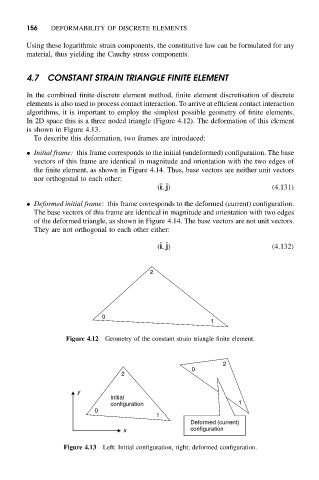
            In 2D space this is a three noded triangle (Figure 4.12). The deformation of this element
            is shown in Figure 4.13.
              To describe this deformation, two frames are introduced:
            • Initial frame: this frame corresponds to the initial (undeformed) configuration. The base
              vectors of this frame are identical in magnitude and orientation with the two edges of
              the finite element, as shown in Figure 4.14. Thus, base vectors are neither unit vectors
              nor orthogonal to each other:
                                                (i, j)                          (4.131)

            • Deformed initial frame: this frame corresponds to the deformed (current) configuration.
              The base vectors of this frame are identical in magnitude and orientation with two edges
              of the deformed triangle, as shown in Figure 4.14. The base vectors are not unit vectors.
              They are not orthogonal to each other either:

                                                (i, j)                          (4.132)
                                                 ˘ ˘


                                              2


                                 0
                                                               1

                       Figure 4.12 Geometry of the constant strain triangle finite element.


                                                                  2
                                                          0
                                      2

                          y
                                   Initial
                                   configuration                      1
                               0
                                                1
                                                         Deformed (current)
                                       x                 configuration

                      Figure 4.13 Left: Initial configuration, right; deformed configuration.

