


Page 286 - The Master Handbook Of Acoustics
P. 286
261
                                                                                REFRACTION OF SOUND


                                                       Wavefronts

                            Uniform    S                                         Ray  A


                           Warm
                          Air temperature  Cool  S                                   B


                            Cool
                                                                                     C
                                       S

                            Warm
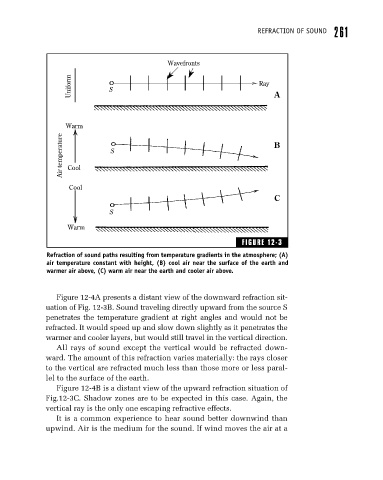
                                                                            FIGURE 12-3

                      Refraction of sound paths resulting from temperature gradients in the atmosphere; (A)
                      air temperature constant with height, (B) cool air near the surface of the earth and
                      warmer air above, (C) warm air near the earth and cooler air above.


                         Figure 12-4A presents a distant view of the downward refraction sit-
                      uation of Fig. 12-3B. Sound traveling directly upward from the source S
                      penetrates the temperature gradient at right angles and would not be
                      refracted. It would speed up and slow down slightly as it penetrates the
                      warmer and cooler layers, but would still travel in the vertical direction.
                         All rays of sound except the vertical would be refracted down-
                      ward. The amount of this refraction varies materially: the rays closer
                      to the vertical are refracted much less than those more or less paral-
                      lel to the surface of the earth.
                         Figure 12-4B is a distant view of the upward refraction situation of
                      Fig.12-3C. Shadow zones are to be expected in this case. Again, the
                      vertical ray is the only one escaping refractive effects.
                         It is a common experience to hear sound better downwind than
                      upwind. Air is the medium for the sound. If wind moves the air at a

