


Page 289 - The Master Handbook Of Acoustics
P. 289
264   CHAPTER TWELVE


                                        N 40°
                                               Bermuda
                                        N 20°


                                           0
                                        Latitude  520°


                                                                                            Perth
                                         540°


                                         560°
                                             W 60°  W 40°  W 20°  0  E 20° E 40°  E 60° E 80° E 100° E 120°
                                                                   Longitude
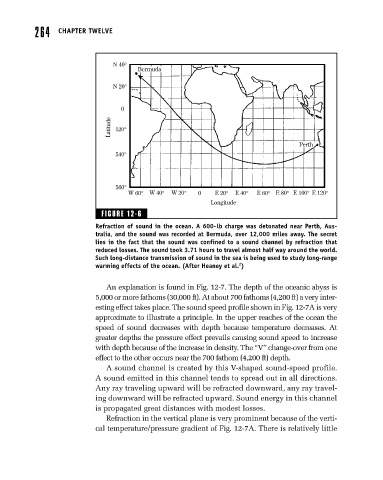
                                     FIGURE 12-6

                                   Refraction of sound in the ocean. A 600-lb charge was detonated near Perth, Aus-
                                   tralia, and the sound was recorded at Bermuda, over 12,000 miles away. The secret
                                   lies in the fact that the sound was confined to a sound channel by refraction that
                                   reduced losses. The sound took 3.71 hours to travel almost half way around the world.
                                   Such long-distance transmission of sound in the sea is being used to study long-range
                                                                           2
                                   warming effects of the ocean. (After Heaney et al. )

                                      An explanation is found in Fig. 12-7. The depth of the oceanic abyss is
                                   5,000 or more fathoms (30,000 ft). At about 700 fathoms (4,200 ft) a very inter-
                                   esting effect takes place. The sound speed profile shown in Fig. 12-7A is very
                                   approximate to illustrate a principle. In the upper reaches of the ocean the
                                   speed of sound decreases with depth because temperature decreases. At
                                   greater depths the pressure effect prevails causing sound speed to increase
                                   with depth because of the increase in density. The “V” change-over from one
                                   effect to the other occurs near the 700 fathom (4,200 ft) depth.
                                      A sound channel is created by this V-shaped sound-speed profile.
                                   A sound emitted in this channel tends to spread out in all directions.
                                   Any ray traveling upward will be refracted downward, any ray travel-
                                   ing downward will be refracted upward. Sound energy in this channel
                                   is propagated great distances with modest losses.
                                      Refraction in the vertical plane is very prominent because of the verti-
                                   cal temperature/pressure gradient of Fig. 12-7A. There is relatively little

