


Page 288 - The Master Handbook Of Acoustics
P. 288
263
                                                                                REFRACTION OF SOUND


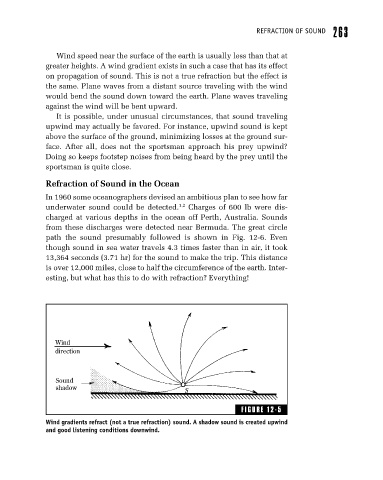
                         Wind speed near the surface of the earth is usually less than that at
                      greater heights. A wind gradient exists in such a case that has its effect
                      on propagation of sound. This is not a true refraction but the effect is
                      the same. Plane waves from a distant source traveling with the wind
                      would bend the sound down toward the earth. Plane waves traveling
                      against the wind will be bent upward.
                         It is possible, under unusual circumstances, that sound traveling
                      upwind may actually be favored. For instance, upwind sound is kept
                      above the surface of the ground, minimizing losses at the ground sur-
                      face. After all, does not the sportsman approach his prey upwind?
                      Doing so keeps footstep noises from being heard by the prey until the
                      sportsman is quite close.

                      Refraction of Sound in the Ocean

                      In 1960 some oceanographers devised an ambitious plan to see how far
                      underwater sound could be detected.  1,2  Charges of 600 lb were dis-
                      charged at various depths in the ocean off Perth, Australia. Sounds
                      from these discharges were detected near Bermuda. The great circle
                      path the sound presumably followed is shown in Fig. 12-6. Even
                      though sound in sea water travels 4.3 times faster than in air, it took
                      13,364 seconds (3.71 hr) for the sound to make the trip. This distance
                      is over 12,000 miles, close to half the circumference of the earth. Inter-
                      esting, but what has this to do with refraction? Everything!


                        Wind
                        direction


                        Sound
                        shadow
                                                            S
                                                                            FIGURE 12-5

                      Wind gradients refract (not a true refraction) sound. A shadow sound is created upwind
                      and good listening conditions downwind.

