


Page 406 - The Mechatronics Handbook
P. 406
0066_frame_C19  Page 28  Wednesday, January 9, 2002  5:17 PM


                         The device so far described can measure acceleration in one direction only, and the output is quadratic
                       in character, that is,


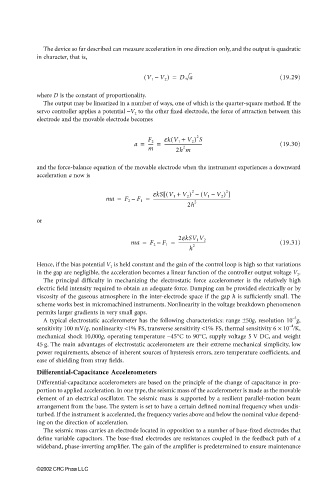
                                                       ( V 1 – V 2 ) =  Da                      (19.29)


                       where D is the constant of proportionality.
                         The output may be linearized in a number of ways, one of which is the quarter-square method. If the
                       servo controller applies a potential −V 2  to the other fixed electrode, the force of attraction between this
                       electrode and the movable electrode becomes


                                                             ekV 1 +(  V 2 ) S
                                                                       2
                                                    a =  ----- =  ----------------------------------  (19.30)
                                                        F 2
                                                                   2
                                                        m       2h m
                       and the force-balance equation of the movable electrode when the instrument experiences a downward
                       acceleration a now is

                                                          ekS V 1 +  V 2 ) –  ( V 1 –  V 2 ) ]
                                                             [
                                                             (
                                                                               2
                                                                     2
                                           ma =  F 2 – F 1 =  ----------------------------------------------------------------------
                                                                    2h 2
                       or
                                                   ma =  F 2 – F 1 =  2ekSV 1 V 2               (19.31)
                                                                 ------------------------
                                                                    h 2

                       Hence, if the bias potential V 1  is held constant and the gain of the control loop is high so that variations
                       in the gap are negligible, the acceleration becomes a linear function of the controller output voltage V 2 .
                         The principal difficulty in mechanizing the electrostatic force accelerometer is the relatively high
                       electric field intensity required to obtain an adequate force. Damping can be provided electrically or by
                       viscosity of the gaseous atmosphere in the inter-electrode space if the gap h is sufficiently small. The
                       scheme works best in micromachined instruments. Nonlinearity in the voltage breakdown phenomenon
                       permits larger gradients in very small gaps.
                                                                                                   −3
                         A typical electrostatic accelerometer has the following characteristics: range ±50g, resolution 10 g,
                                                                                                  −4
                       sensitivity 100 mV/g, nonlinearity <1% FS, transverse sensitivity <1% FS, thermal sensitivity 6 × 10 /K,
                       mechanical shock 10,000g, operating temperature −45°C to 90°C, supply voltage 5 V DC, and weight
                       45 g. The main advantages of electrostatic accelerometers are their extreme mechanical simplicity, low
                       power requirements, absence of inherent sources of hysteresis errors, zero temperature coefficients, and
                       ease of shielding from stray fields.
                       Differential-Capacitance Accelerometers
                       Differential-capacitance accelerometers are based on the principle of the change of capacitance in pro-
                       portion to applied acceleration. In one type, the seismic mass of the accelerometer is made as the movable
                       element of an electrical oscillator. The seismic mass is supported by a resilient parallel-motion beam
                       arrangement from the base. The system is set to have a certain defined nominal frequency when undis-
                       turbed. If the instrument is accelerated, the frequency varies above and below the nominal value depend-
                       ing on the direction of acceleration.
                         The seismic mass carries an electrode located in opposition to a number of base-fixed electrodes that
                       define variable capacitors. The base-fixed electrodes are resistances coupled in the feedback path of a
                       wideband, phase-inverting amplifier. The gain of the amplifier is predetermined to ensure maintenance


                       ©2002 CRC Press LLC

