


Page 208 - Theory and Design of Air Cushion Craft
P. 208
Water  surface deformation  in ACV air  cushion  191

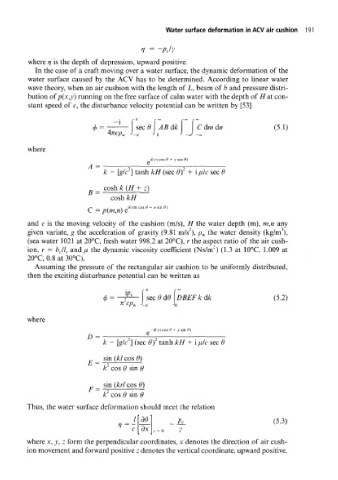
                                          n  =  -pjy
           where  rj  is the  depth  of  depression, upward  positive.
             In the case of  a craft  moving over a water surface, the dynamic deformation of  the
           water  surface  caused  by the  ACV has  to  be  determined.  According  to  linear  water
           wave theory, when an air cushion with the length of L, beam of  b and pressure distri-
           bution of p(x,y)  running on the free  surface of calm water with the depth of H at con-
           stant  speed  of  c, the disturbance velocity potential can  be written by [53]

                                  —i   r      r      r r
                                       \SQc9\ABdk\       Cdmdn               (5.1)
                                 4ncp v
                                       J-TT  J 0     J -J  -oo
          where
                                            ik(xcos  0 +  v sin 6)
                           A=              e
                               k  -  [g/c~]  tanh  kH  (sec 0)  +  i file  sec 9

                                cosh k  (H  +  z)
                           B =
                                 cosh  kH
                           C  = p(m,ri)  e iA-(m cos 0 + n sin 0)
          and  c is the  moving  velocity  of  the  cushion  (m/s), // the  water  depth  (m),  m,n any
                                                       2
          given  variate,  g  the  acceleration  of  gravity (9.81 m/s ),  /? w  the  water  density  (kg/m ),
          (sea water  1021 at  20°C, fresh  water 998.2 at  20°C), r the  aspect  ratio  of  the  air  cush-
                                                              2
          ion,  r  =  bjl c  and//  the  dynamic viscosity coefficient  (Ns/m ) (1.3 at  10°C,  1.009 at
          20°C,  0.8 at  30°C).
            Assuming the pressure of  the rectangular air cushion to  be uniformly  distributed,
          then  the exciting  disturbance  potential can be written  as

                                          r        r~
                                           sec0d0  \DBEF kdk                 (5.2)
                                          J— rr    JO
          where


                           £>         2      2
                                 -  [g/c ]  (sec  9)  tanh kH  + i ju/c sec
                               sin  (kl  cos
                               —
                               Ac  cos  9  sin

                             _ sin  (krl  cos
                           J*  — —
                                  cos 9  sin 0
          Thus, the water  surface  deformation  should  meet the  relation
                                                  _  PL.                      (5-3)
                                               =  o  y

          where x, y, z form the perpendicular  coordinates,  x denotes  the direction  of air cush-
          ion movement and forward positive z denotes the vertical coordinate, upward positive.

