


Page 214 - Theory and Design of Air Cushion Craft
P. 214
Water  surface  deformation  in SES air  cushion  197


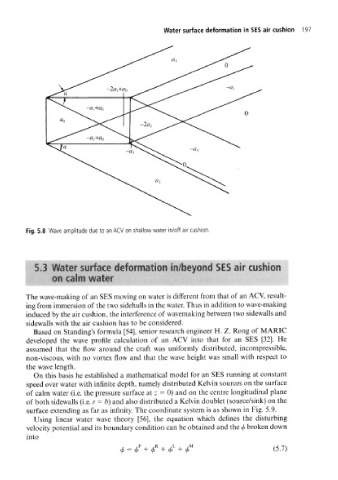
          Fig.  5.8  Wave amplitude due to  an ACV on shallow water  in/off  air cushion.


             5.3  Water  surface deformation in/beyond        SES   air  cushion
                 on  calm water


          The wave-making of  an  SES moving on water is different  from that of  an ACV, result-
          ing from immersion of the two sidehulls in the water. Thus in addition to wave-making
          induced  by the air cushion, the interference of wavemaking between two sidewalls and
          sidewalls with the air cushion  has to be  considered.
            Based  on Standing's  formula [54], senior research  engineer H. Z. Rong of MARIC
          developed  the  wave  profile  calculation  of  an  ACV  into  that  for  an  SES  [32].  He
          assumed  that  the  flow  around  the  craft  was  uniformly distributed,  incompressible,
          non-viscous,  with no  vortex flow and  that  the  wave height  was small with respect  to
          the  wave length.
            On this basis he established  a mathematical  model  for an  SES running at  constant
          speed  over water with infinite depth, namely distributed Kelvin sources on the surface
          of  calm water  (i.e. the pressure surface at z  =  0) and  on the centre longitudinal plane
          of both sidewalls (i.e. r = b) and also distributed  a Kelvin doublet (source/sink) on the
          surface extending as far  as infinity.  The coordinate  system is as shown  in Fig.  5.9.
            Using  linear  water  wave  theory  [56],  the  equation  which  defines  the  disturbing
          velocity potential and  its boundary  condition can  be obtained  and  the  <f> broken  down
          into
                                    A  = / + / + / + f                        (5.7)

