


Page 215 - Theory and Design of Air Cushion Craft
P. 215
198  Trim and water  surface deformation  under the cushion


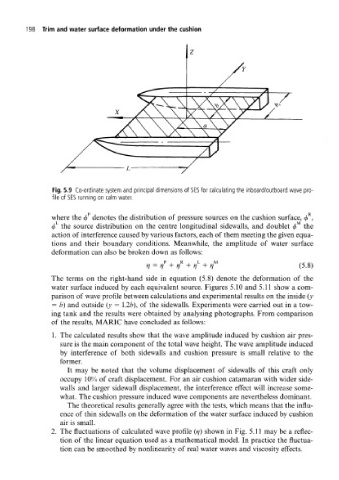
             Fig.  5.9  Co-ordinate  system and  principal  dimensions  of  SES for  calculating  the  inboard/outboard  wave pro-
             file  of  SES running  on  calm  water.

                       P                                                            R
             where the  (/>  denotes  the  distribution of  pressure  sources  on  the  cushion  surface,  </> ,
             (f>  the  source  distribution  on  the  centre  longitudinal  sidewalls,  and  doublet  <£  the
             action of  interference caused by various factors, each of them meeting the given equa-
             tions  and  their  boundary  conditions.  Meanwhile,  the  amplitude  of  water  surface
             deformation  can  also be broken down as  follows:
                                            P  .  R  .  L  .  M
                                         =  77  +  rj  +  77  +77                (5.8)
             The  terms  on  the  right-hand  side  in  equation  (5.8) denote  the  deformation  of  the
             water surface induced by each equivalent source.  Figures  5.10 and  5.11  show a  com-
             parison  of  wave profile  between calculations and  experimental results on the inside  (y
             =  b) and  outside  (y  =  1.2/3),  of  the  sidewalls. Experiments were carried  out  in a tow-
             ing tank  and  the  results were obtained  by analysing photographs.  From  comparison
             of  the results, MARIC have concluded  as follows:
             1.  The  calculated  results show that  the  wave amplitude induced  by cushion  air  pres-
                sure is the main component  of  the total wave height. The wave amplitude induced
                by  interference  of  both  sidewalls  and  cushion  pressure  is  small  relative  to  the
                former.
                  It  may  be  noted  that  the  volume  displacement  of  sidewalls of  this  craft  only
                occupy  10% of  craft displacement.  For  an  air cushion catamaran  with wider side-
                walls  and  larger  sidewall displacement,  the  interference effect  will increase  some-
                what. The cushion pressure induced wave components  are nevertheless dominant.
                  The theoretical results generally agree with the tests, which means that  the  influ-
                ence of  thin  sidewalls on the deformation of  the water surface induced by cushion
                air  is small.
             2.  The  fluctuations  of  calculated  wave profile (77) shown  in  Fig.  5.11 may  be  a  reflec-
                tion  of  the linear  equation  used as a mathematical  model.  In practice the fluctua-
                tion can  be smoothed  by nonlinearity of  real water waves and  viscosity  effects.

