


Page 366 - Thermal Hydraulics Aspects of Liquid Metal Cooled Nuclear Reactors
P. 366
330                   Thermal Hydraulics Aspects of Liquid Metal Cooled Nuclear Reactors

         study allowed to correctly locate the instrumentation in order to fully capture the
         blockage phenomena and the temperature maxima. On the other side, experimental
         results will allow to validate CFD model and then reapply them to the larger scale
         to a real reactor fuel assembly. Naveen Raj and Velusamy (2017) performed a similar
         study for wire-wrapped fuel assemblies. They observe large reverse-flow zones and
         conclude that detection of relatively small blockages occupying only one or a few sub-
         channels through temperature measurements at the outlet will be almost impossible.
            Naveen et al. (2016) analyze the impact of porous blockages in a sodium-cooled
         fuel assembly. They conclude that the temperature nonuniformity caused by the wake
         behind the blockage persists even up to three helical pitch lengths but still global bulk
         sodium temperature monitoring at the outlet is not likely to detect slowly growing
         blockages. Furthermore, they conclude that the peak cladding temperature is strongly
         dependent on the assumed porosity of the blockage. Finally, they observe that rods
         partially exposed to the porous blockage show large circumferential temperature
         variations resulting in high thermal stress in the rods.


         6.2.3.4.2 Blockages due to lost objects or migrating parts

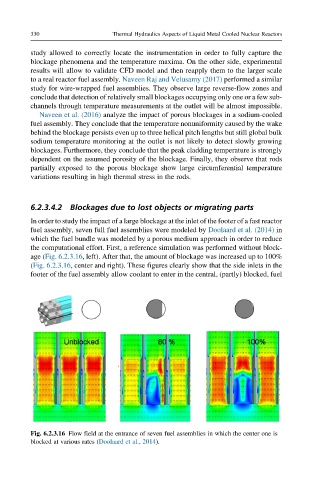
         In order to study the impact of a large blockage at the inlet of the footer of a fast reactor
         fuel assembly, seven full fuel assemblies were modeled by Doolaard et al. (2014) in
         which the fuel bundle was modeled by a porous medium approach in order to reduce
         the computational effort. First, a reference simulation was performed without block-
         age (Fig. 6.2.3.16, left). After that, the amount of blockage was increased up to 100%
         (Fig. 6.2.3.16, center and right). These figures clearly show that the side inlets in the
         footer of the fuel assembly allow coolant to enter in the central, (partly) blocked, fuel


         Fig. 6.2.3.16 Flow field at the entrance of seven fuel assemblies in which the center one is
         blocked at various rates (Doolaard et al., 2014).

