


Page 368 - Thermal Hydraulics Aspects of Liquid Metal Cooled Nuclear Reactors
P. 368
332                   Thermal Hydraulics Aspects of Liquid Metal Cooled Nuclear Reactors


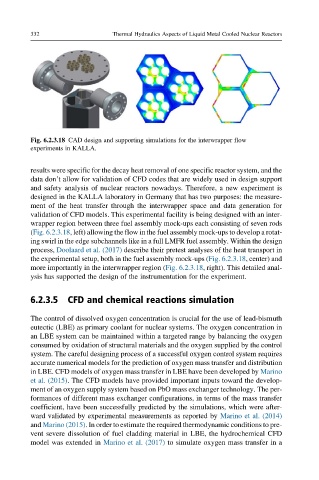
         Fig. 6.2.3.18 CAD design and supporting simulations for the interwrapper flow
         experiments in KALLA.

         results were specific for the decay heat removal of one specific reactor system, and the
         data don’t allow for validation of CFD codes that are widely used in design support
         and safety analysis of nuclear reactors nowadays. Therefore, a new experiment is
         designed in the KALLA laboratory in Germany that has two purposes: the measure-
         ment of the heat transfer through the interwrapper space and data generation for
         validation of CFD models. This experimental facility is being designed with an inter-
         wrapper region between three fuel assembly mock-ups each consisting of seven rods
         (Fig. 6.2.3.18, left) allowing the flow in the fuel assembly mock-ups to develop a rotat-
         ing swirl in the edge subchannels like in a full LMFR fuel assembly. Within the design
         process, Doolaard et al. (2017) describe their pretest analyses of the heat transport in
         the experimental setup, both in the fuel assembly mock-ups (Fig. 6.2.3.18, center) and
         more importantly in the interwrapper region (Fig. 6.2.3.18, right). This detailed anal-
         ysis has supported the design of the instrumentation for the experiment.


         6.2.3.5   CFD and chemical reactions simulation

         The control of dissolved oxygen concentration is crucial for the use of lead-bismuth
         eutectic (LBE) as primary coolant for nuclear systems. The oxygen concentration in
         an LBE system can be maintained within a targeted range by balancing the oxygen
         consumed by oxidation of structural materials and the oxygen supplied by the control
         system. The careful designing process of a successful oxygen control system requires
         accurate numerical models for the prediction of oxygen mass transfer and distribution
         in LBE. CFD models of oxygen mass transfer in LBE have been developed by Marino
         et al. (2015). The CFD models have provided important inputs toward the develop-
         ment of an oxygen supply system based on PbO mass exchanger technology. The per-
         formances of different mass exchanger configurations, in terms of the mass transfer
         coefficient, have been successfully predicted by the simulations, which were after-
         ward validated by experimental measurements as reported by Marino et al. (2014)
         and Marino (2015). In order to estimate the required thermodynamic conditions to pre-
         vent severe dissolution of fuel cladding material in LBE, the hydrochemical CFD
         model was extended in Marino et al. (2017) to simulate oxygen mass transfer in a

