


Page 367 - Thermal Hydraulics Aspects of Liquid Metal Cooled Nuclear Reactors
P. 367
Core thermal hydraulics                                           331


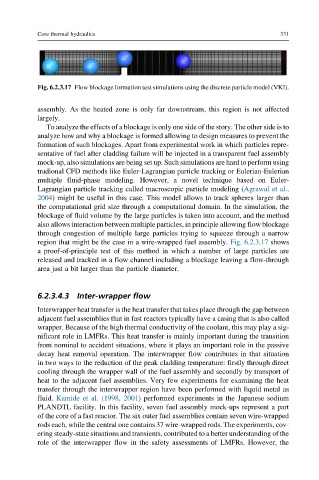
           Fig. 6.2.3.17 Flow blockage formation test simulations using the discrete particle model (VKI).


           assembly. As the heated zone is only far downstream, this region is not affected
           largely.
              To analyze the effects of a blockage is only one side of the story. The other side is to
           analyze how and why a blockage is formed allowing to design measures to prevent the
           formation of such blockages. Apart from experimental work in which particles repre-
           sentative of fuel after cladding failure will be injected in a transparent fuel assembly
           mock-up, also simulations are being set up. Such simulations are hard to perform using
           tradional CFD methods like Euler-Lagrangian particle tracking or Eulerian-Eulerian
           multiple fluid-phase modeling. However, a novel technique based on Euler-
           Lagrangian particle tracking called macroscopic particle modeling (Agrawal et al.,
           2004) might be useful in this case. This model allows to track spheres larger than
           the computational grid size through a computational domain. In the simulation, the
           blockage of fluid volume by the large particles is taken into account, and the method
           also allows interaction between multiple particles, in principle allowing flow blockage
           through congestion of multiple large particles trying to squeeze through a narrow
           region that might be the case in a wire-wrapped fuel assembly. Fig. 6.2.3.17 shows
           a proof-of-principle test of this method in which a number of large particles are
           released and tracked in a flow channel including a blockage leaving a flow-through
           area just a bit larger than the particle diameter.


           6.2.3.4.3 Inter-wrapper flow

           Interwrapper heat transfer is the heat transfer that takes place through the gap between
           adjacent fuel assemblies that in fast reactors typically have a casing that is also called
           wrapper. Because of the high thermal conductivity of the coolant, this may play a sig-
           nificant role in LMFRs. This heat transfer is mainly important during the transition
           from nominal to accident situations, where it plays an important role in the passive
           decay heat removal operation. The interwrapper flow contributes in that situation
           in two ways to the reduction of the peak cladding temperature: firstly through direct
           cooling through the wrapper wall of the fuel assembly and secondly by transport of
           heat to the adjacent fuel assemblies. Very few experiments for examining the heat
           transfer through the interwrapper region have been performed with liquid metal as
           fluid. Kamide et al. (1998, 2001) performed experiments in the Japanese sodium
           PLANDTL facility. In this facility, seven fuel assembly mock-ups represent a part
           of the core of a fast reactor. The six outer fuel assemblies contain seven wire-wrapped
           rods each, while the central one contains 37 wire-wrapped rods. The experiments, cov-
           ering steady-state situations and transients, contributed to a better understanding of the
           role of the interwrapper flow in the safety assessments of LMFRs. However, the

