


Page 245 - Bird R.B. Transport phenomena
P. 245
Problems  229

                    (с)  Combine the results  of  (a) and (b). Solve the resulting  differential  equation with  an appro-
                    priate initial condition to get the liquid  level z as a function  of t. From this get the efflux  time


                                                 efflux                                (7B.10-3)
                    List  all  the assumptions  that have  been made and discuss  how  serious  they  are. How  could
                    these assumptions be  avoided?
                    (d)  Rework part (b) by  choosing plane 1 to be stationary and slightly  below  the liquid  surface
                    at time t. It is understood that the liquid  surface  does not go below  plane 1 during  the  differ-
                    ential time interval dt over  which the unsteady  mechanical energy  balance is made. With  this
                    choice  of  plane  1 the derivative  d<3> /dt  is  zero  and  there is  no work  term  W . Furthermore
                                                  tot
                                                                                    m
                    the conditions at plane  1 are very  nearly  those  at the liquid  surface.  Then with  the pseudo-
                    steady-state  approximation that the derivative  dK /dt  is approximately  zero and the neglect
                                                           tot
                    of the viscous  loss term, the mechanical energy balance, with w l  = zv  takes the form
                                                                          2/
                                               0 -  \{v\ -  vl)  -  h )                (7B.10-4)
                                                                  2
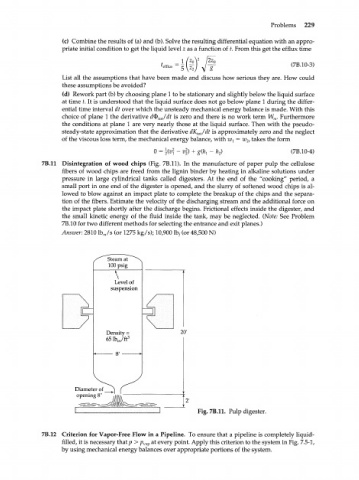
              7B.11  Disintegration  of  wood  chips  (Fig.  7B.11).  In the manufacture  of  paper  pulp  the  cellulose
                    fibers  of  wood  chips are  freed  from  the lignin  binder by  heating in alkaline  solutions under
                    pressure  in  large  cylindrical  tanks  called  digesters.  At  the  end  of  the  "cooking"  period, a
                    small  port in one end  of  the digester  is  opened, and the slurry  of  softened  wood  chips  is  al-
                    lowed  to blow  against  an impact plate to complete the breakup  of  the chips and  the separa-
                    tion  of  the fibers.  Estimate the velocity  of  the discharging  stream and the additional  force on
                    the impact plate shortly  after  the discharge  begins.  Frictional effects  inside  the digester,  and
                    the  small  kinetic  energy  of  the  fluid  inside  the  tank, may  be  neglected.  (Note: See  Problem
                    7B.10 for  two different  methods for  selecting  the entrance and exit  planes.)
                   Answer:  2810 lb /s  (or 1275 kg/s);  10,900 \h (or 48,500 N)
                                m                      f


                                                           Fig. 7B.11.  Pulp  digester.


              7B.12  Criterion for  Vapor-Free Flow in  a Pipeline.  To ensure that a pipeline  is  completely  liquid-
                    filled,  it is necessary  that p >  p vap  at every  point. Apply  this criterion to the system  in Fig. 7.5-1,
                   by using  mechanical energy  balances over appropriate portions of the system.

