


Page 246 - Bird R.B. Transport phenomena
P. 246
230   Chapter 7  Macroscopic Balances for Isothermal Flow Systems

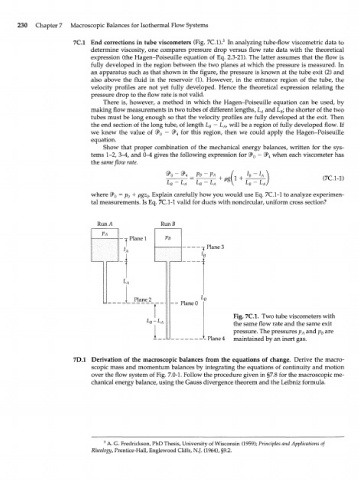
                       7C.1 End  corrections in  tube viscometers  (Fig. 7C.1). 3  In analyzing  tube-flow  viscometric  data to
                            determine  viscosity, one compares pressure  drop versus  flow  rate data  with  the theoretical
                            expression  (the Hagen-Poiseuille equation  of  Eq. 2.3-21). The latter assumes  that the flow is
                            fully  developed  in the region between  the two  planes  at which  the pressure  is  measured. In
                            an apparatus such as that shown  in the figure,  the pressure  is known  at the tube exit  (2) and
                            also  above  the  fluid  in  the  reservoir  (1). However,  in  the  entrance region  of  the  tube, the
                            velocity  profiles  are  not  yet  fully  developed.  Hence the  theoretical  expression  relating  the
                            pressure drop to the flow rate is not valid.
                                There  is,  however,  a  method  in  which  the  Hagen-Poiseuille  equation  can  be  used,  by
                            making flow measurements in two tubes  of different  lengths, L  and L ; the shorter of the two
                                                                                    B
                                                                              A
                            tubes must be long enough  so that the velocity  profiles  are fully  developed  at the exit. Then
                            the end section of the long tube, of length L  -  L , will be a region  of  fully  developed flow. If
                                                               B
                                                                   A
                                                   (
                                                     >
                            we  knew  the value  of  ^?  - 3  for  this  region,  then we  could  apply  the  Hagen-Poiseuille
                                                     A
                                                 0
                            equation.
                                Show  that proper  combination  of  the  mechanical energy  balances, written  for  the  sys-
                            tems  1-2,  3-4, and  0-4 gives the following  expression  for  9> -  9> when  each viscometer  has
                                                                                4
                                                                            0
                            the same flow rate.
                                                                                                (7C.1-1)
                                                                             L
                            where  2P = p 0  + pgz . Explain carefully  how you would  use Eq. 7C.1-1 to analyze experimen-
                                             0
                                   0
                            tal measurements. Is Eq. 7C.1-1 valid  for ducts with noncircular, uniform cross section?
                              Run  Л            Run В


                                                                      Fig. 7C.1. Two tube viscometers  with
                                                                      the same flow rate and the same exit
                                                                      pressure. The pressures p A  and p  are
                                                                                               B
                                                             '- Plane 4  maintained by an inert gas.

                       7D.1  Derivation  of  the  macroscopic balances  from  the  equations  of  change.  Derive  the macro-
                            scopic mass  and momentum balances by  integrating the equations  of  continuity and motion
                            over the flow system  of Fig. 7.0-1. Follow the procedure given  in §7.8 for the macroscopic me-
                            chanical energy balance, using the Gauss divergence  theorem and the Leibniz formula.


                                3  A. G. Fredrickson, PhD Thesis, University  of Wisconsin  (1959); Principles and Applications of
                            Rheology, Prentice-Hall, Englewood  Cliffs,  N.J. (1964), §9.2.

