


Page 566 - Bird R.B. Transport phenomena
P. 566
546  Chapter 18  Concentration Distributions in Solids and in Laminar Flow

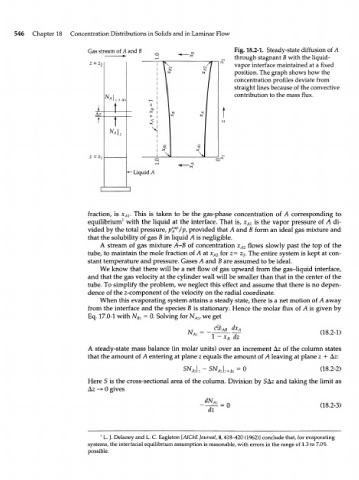
                           Gas stream of A and В                      Fig.  18.2-1.  Steady-state diffusion  of A
                                                                      through stagnant В with the liquid-
                                                                      vapor interface maintained at a fixed
                                                                      position. The graph shows  how the
                                                                      concentration profiles  deviate  from
                                                                      straight lines because  of the convective
                                                                      contribution to the mass  flux.


                           fraction,  is  x .  This  is  taken  to  be  the  gas-phase  concentration of  A  corresponding  to
                                      M
                           equilibrium  1  with  the liquid  at  the interface.  That is, x Al  is  the vapor  pressure  of  A  di-
                                                    a?
                           vided  by  the total pressure, p\ /p,  provided  that A  and В form an ideal gas  mixture and
                           that the solubility  of gas  В in liquid  A  is  negligible.
                               A  stream  of  gas  mixture  A-B  of  concentration x A2  flows  slowly  past  the top  of  the
                           tube, to maintain the mole fraction  of A  at x A2  for z= z . The entire system  is kept at con-
                                                                         2
                           stant temperature and pressure. Gases A  and В are assumed  to be ideal.
                               We  know  that there will be a net flow  of  gas  upward  from  the gas-liquid  interface,
                           and  that the gas  velocity  at the cylinder wall will be smaller than that in the center of the
                           tube. To simplify  the problem, we  neglect  this  effect  and assume  that there is no depen-
                           dence of the z-component of the velocity  on the radial coordinate.
                               When  this evaporating  system  attains a steady  state, there is a net motion of A  away
                           from  the interface and the species  В is  stationary. Hence the molar flux  of  A  is  given  by
                           Eq.  17.0-1 with  N Bz  = 0. Solving  for N ,  we  get
                                                          Az
                                                                     dx
                                                                       A                       (18.2-1)
                                                               1  -  х  л  dz
                           A  steady-state  mass  balance  (in molar units) over  an increment  Az  of  the column states
                           that the amount of A  entering at plane z equals the amount of A  leaving  at plane z  +  Az:
                                                       SN L  -  SN A                           (18.2-2)
                                                         A
                           Here  S is  the cross-sectional  area  of  the column. Division  by  SAz and taking  the limit  as
                           Az  —» 0 gives
                                                             dN
                                                                Az  =  0                       (18.2-3)
                                                              dz


                               1  L. J. Delaney and L. C. Eagleton [AIChE Journal, 8, 418^120 (1962)] conclude that, for evaporating
                           systems, the interfacial  equilibrium assumption is reasonable, with errors in the range of 1.3 to 7.0%
                           possible.

