


Page 568 - Bird R.B. Transport phenomena
P. 568
548   Chapter 18  Concentration Distributions in Solids  and in Laminar Flow

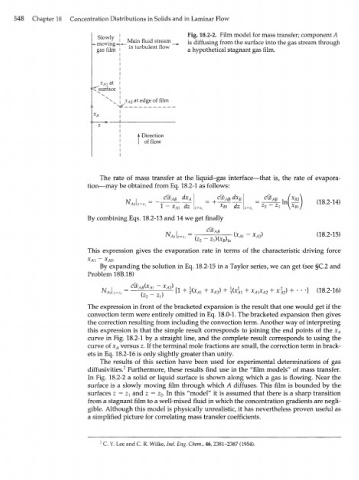
                                                        Fig. 18.2-2.  Film model for  mass  transfer; component A
                              Slowly   Main fluid  stream
                             -moving-*-]-  in turbulent  flow  is diffusing  from  the surface  into the gas  stream through
                              gas  film                 a hypothetical stagnant gas  film.


                             ^  A l
                             ^surface
                                         at edge  of  film
                                      x A2


                                          A Direction
                                            of  flow


                               The  rate  of  mass  transfer  at  the  liquid-gas  interface—that  is,  the  rate  of  evapora-
                           tion—may be obtained from  Eq. 18.2-1 as  follows:
                                                                     \dx
                                                 c9> AB                B               ^       (18.2-14)
                                                1  -  x  dz  = +-    '  dz
                                                     M
                           By combining  Eqs. 18.2-13 and  14 we  get  finally

                                                                           x )                (18.2-15)
                                                          fe "              A2
                                                             2
                           This  expression  gives  the  evaporation  rate  in  terms  of  the  characteristic  driving  force
                           X     X
                           A\  ~~  A2-
                               By expanding  the solution  in Eq. 18.2-15  in a Taylor  series, we  can get  (see §C2 and
                           Problem  18B.18)

                               N,                              x )         x x    x )         (18.2-16)
                                                                                   2
                                           (z 2  -              A1          M A2   A2
                           The expression  in front  of  the bracketed  expansion  is the result  that one would  get  if the
                           convection term were  entirely  omitted  in Eq. 18.0-1. The bracketed  expansion  then gives
                           the correction resulting  from  including the convection term. Another way  of interpreting
                           this  expression  is  that the simple  result  corresponds  to joining  the end  points  of  the  x A
                           curve  in  Fig.  18.2-1  by  a  straight  line, and  the complete result  corresponds  to using  the
                           curve  of x A  versus  z.  If the terminal mole fractions  are small, the correction term in brack-
                           ets in Eq. 18.2-16 is only slightly  greater than unity.
                               The  results  of  this  section  have  been  used  for  experimental  determinations  of  gas
                           diffusivities. 2  Furthermore, these  results  find  use  in the  "film  models"  of  mass  transfer.
                           In  Fig.  18.2-2  a  solid  or  liquid  surface  is  shown  along  which  a  gas  is  flowing.  Near  the
                           surface  is  a slowly  moving  film  through  which  A  diffuses.  This  film  is bounded  by  the
                           surfaces  z  = z }  and  z  = z .  In this  "model"  it  is  assumed  that there is  a sharp  transition
                                                2
                           from  a stagnant  film  to a well-mixed  fluid  in which the concentration gradients are negli-
                           gible.  Although  this model  is  physically  unrealistic, it has nevertheless  proven  useful  as
                           a simplified  picture for  correlating mass  transfer  coefficients.


                               2
                                С  Y. Lee and  C. R. Wilke, lnd.  Eng.  Chem., 46, 2381-2387  (1954).

