


Page 572 - Bird R.B. Transport phenomena
P. 572
552   Chapter 18  Concentration Distributions in Solids and in Laminar Flow
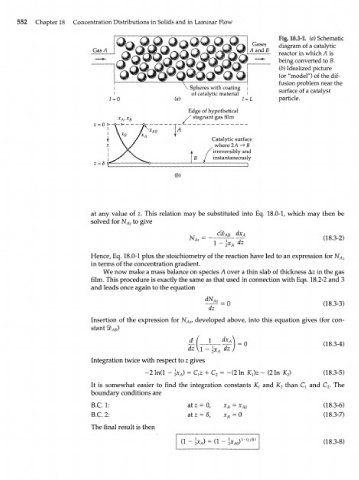
                                                                                   Fig. 18.3-1.  (a) Schematic
                                                                                   diagram  of a catalytic
                                                                                   reactor in which A  is
                                                                                   being converted to B.
                                                                                   (b) Idealized picture
                                                                                   (or "model") of the  dif-
                                                                                   fusion  problem near the
                                                         Spheres with coating  |   surface  of a catalyst
                                                         of catalytic material  I
                                  1 = 0             (a)                 1 = 1      particle.
                                                         Edge  of hypothetical
                                                        X  stagnant gas  film


                                                               Catalytic  surface
                                                                where  2 A  -> В
                                                                irreversibly  and
                                                                instantaneously
                                                                          1
                                                     (b)


                            at  any  value  of  z.  This  relation  may  be  substituted  into  Eq.  18.0-1, which  may  then  be
                            solved  for  N Az  to give
                                                                      dx
                                                         N*  =  --      A                       (18.3-2)
                                                                 -  \x  dz
                                                                     A
                            Hence, Eq. 18.0-1 plus  the stoichiometry  of  the reaction have  led  to an expression  for  N
                                                                                                     Az
                            in terms  of the concentration gradient.
                                We  now make a mass balance on species  A  over  a thin slab  of thickness  Az in the  gas
                            film.  This procedure is exactly  the same as that used  in connection with  Eqs. 18.2-2 and 3
                            and leads  once again  to the equation
                                                             dN
                                                                Az  = 0                         (18.3-3)
                                                              dz
                            Insertion  of  the expression  for  N Az/  developed  above,  into  this  equation  gives  (for  con-
                            stant ЯЬ )
                                   АВ
                                                         d    1    dx,  = 0                     (18.3-4)
                                                        dz  Vl  -  \x  dz
                                                                 A
                            Integration twice with  respect  to z gives
                                            -2  ln(l  -  \x )  = Qz  + C  = -(2  In  K )z  -  (2 In  K )  (18.3-5)
                                                      A          2         x         2
                            It  is  somewhat  easier  to  find  the  integration  constants  K^ and  K 2  than  Q  and  C . The
                                                                                                 2
                            boundary  conditions are
                            B.C. 1:                     at z  = o,  X 'A  =  x  A 0             (18.3-6)
                            B.C. 2:                     at z =  8,  лA  =  0                    (18.3-7)
                            The final result is then
                                                      (1 -  hсл) = (1  - 2 A0>                  (18.3-8)
                                                                    l
                                                                       \\~(z/8)
                                                                     X

