


Page 570 - Bird R.B. Transport phenomena
P. 570
550  Chapter 18  Concentration Distributions in Solids and in Laminar Flow

                           Then from  Eq. 18.2-14  we  get


                                                        c\n(x /x )
                                                               B]
                                                             B2
                                                       (N \ ._ )(z -z,)RT
                                                         A z
                                                            z
                                                              2
                                                                9
                                                       (7.26  X  1(Г )(17Л)(82.06)(273)
                                                     "  (755/760X2.303  lo (755/722))
                                                                      gl0
                                                     =  0.0636 cm /s                           (18.2-21)
                                                               2
                           This  method  of  determining  gas-phase  diffusivities  suffers  from  several  defects:  the  cooling
                           of  the liquid  by  evaporation, the concentration of  nonvolatile  impurities  at the interface, the
                           climbing  of the liquid up the walls  of the tube, and the curvature  of the meniscus.

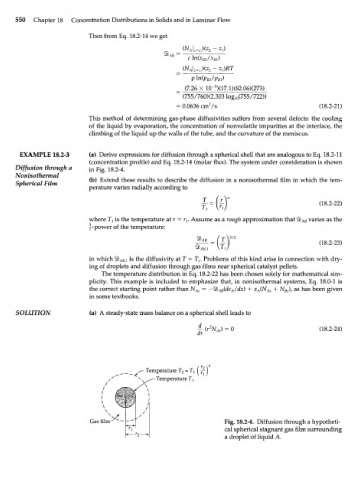
       EXAMPLE   18.2-3    (a)  Derive expressions  for  diffusion  through a spherical  shell  that are analogous  to Eq.  18.2-11
                           (concentration profile)  and Eq. 18.2-14  (molar flux).  The system  under consideration is  shown
      Diffusion  through  a  in Fig.  18.2-4.
      Nonisothermal        (b)  Extend  these  results  to describe  the diffusion  in a nonisothermal  film  in which  the tem-
      Spherical  Film
                           perature varies  radially  according to
                                                             T  _ { r
                                                                                               (18.2-22)

                           where  T, is the temperature at r = r,. Assume  as a rough approximation that %  varies  as the
                                                                                           AB
                           §-power  of the temperature:
                                                                     3/2
                                                            »AB
                                                                                               (18.2-23)
                                                            AB,\
                                                           V
                           in which ЯЬ  is the diffusivity  at T = T . Problems  of  this kind arise  in connection with  dry-
                                                            }
                                     АВА
                           ing  of droplets and diffusion  through gas  films  near spherical catalyst  pellets.
                               The temperature distribution in Eq. 18.2-22 has been chosen solely  for  mathematical sim-
                           plicity.  This  example  is  included  to emphasize  that, in  nonisothermal systems,  Eq.  18.0-1  is
                           the correct starting  point rather than N Az  =  -% (dcJdz)  + x {N Az  + N ), as has been  given
                                                                 AB
                                                                             A
                                                                                     Bz
                           in some textbooks.
      SOLUTION              (a)  A steady-state  mass balance on a spherical shell leads to
                                                             2
                                                           f(rN )  = 0                         (18.2-24)
                                                               Ar
                                                            r


                                         s*^ Temperature T  = Tj
                                                       2
                                              -Temperature T]
                               i \ I     <  \ 1 \ \


                                 \  у     у  у
                            Gas  film ^^ ~~                        Fig. 18.2-4.  Diffusion  through a hypotheti-
                                                                   cal spherical stagnant gas  film  surrounding
                                      ^  r 2  ^
                                                                   a droplet  of liquid  A.

