


Page 656 - Bird R.B. Transport phenomena
P. 656
636  Chapter 20  Concentration Distributions with  More Than One Independent Variable

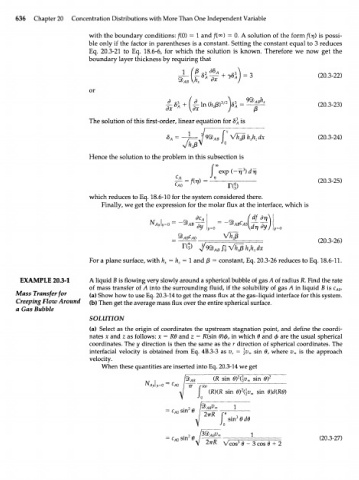
                           with  the boundary  conditions: /(0)  = 1 and /(°°)  = 0. A  solution  of  the form/(17)  is  possi-
                           ble  only  if  the factor  in parentheses  is  a constant. Setting  the constant equal  to 3 reduces
                           Eq.  20.3-21  to  Eq.  18.6-6,  for  which  the  solution  is  known.  Therefore  we  now  get  the
                           boundary  layer  thickness by  requiring that

                                                       1  - s '                                (20.3-22)
                                                             2
                                                       1 AB  \h x
                           or

                                                                                               (20.3-23)
                                                                            P
                                                                      3
                           The  solution  of  this first-order,  linear equation  for  8  is
                                                                       A
                                                                                               (20.3-24)
                                                  ^  A  =
                           Hence the solution to the problem in this subsection  is
                                                               f  °°   _   _
                                                                 exp  (-17) drj
                                                               J  7J                           (20.3-25)

                           which reduces  to Eq. 18.6-10 for  the system  considered there.
                               Finally, we  get the expression  for  the molar flux  at the interface, which  is

                                             N
                                               A

                                                                                               (20.3-26)
                                                       г
                                                       Сз)  $93> АВ  ft  Vhjihji dx
                                                                            z
                           For  a plane surface,  with  h x  = h z  = 1 and  /3 = constant, Eq. 20.3-26 reduces to Eq. 18.6-11.

       EXAMPLE   20.3-1     A liquid  В is flowing very slowly around a spherical bubble  of gas A  of radius R. Find the rate
                           of  mass  transfer  of  A  into the surrounding  fluid,  if  the solubility  of  gas  A  in liquid  В is  c .
                                                                                                    A0
      Mass  Transfer for    (a) Show how  to use  Eq. 20.3-14  to get the mass  flux  at the gas-liquid  interface  for  this  system.
      Creeping Flow Around  (b) Then get the average  mass  flux  over the entire spherical  surface.
      a  Gas Bubble
                            SOLUTION
                            (a)  Select  as  the origin  of  coordinates the upstream  stagnation  point, and  define  the coordi-
                            nates x and z as  follows: x  = R0 and z  = K(sin 0)ф, in which  6 and  ф are the usual  spherical
                            coordinates. The у  direction is  then the same  as  the r direction  of  spherical  coordinates. The
                            interfacial  velocity  is  obtained  from  Eq.  4B.3-3  as  v s  =  \v^  sin  в, where  v x  is  the approach
                            velocity.
                               When  these quantities are inserted  into Eq. 20.3-14  we  get


                                                                                               (20.3-27)
                                                                       3
                                                              27rR  Vcos  в -  3 cos в + 2

