


Page 298 - Tribology in Machine Design
P. 298
Lubrication and efficiency of involute gears  283


                                 it is clear that there are, at least, two competing failure mechanisms; one
                                 associated with inclusions in the material of the gear and the other with
                                 surface roughness and lubrication. A material with many internal imperfec-
                                 tions is likely to fail by subsurface fatigue, and the life of the gear made of it
                                 will show little dependence on the ratio of the oil film thickness to the
                                 surface roughness. An inclusion free material will have a much longer life
                                 depending strongly on the oil film thickness to surface roughness ratio.
                                 Improvements in the manufacture of materials, mean that in practice,
                                 surface originated failures dominate, and therefore that surface roughness is
                                 now a critical factor.
                                   There are a number of different types of pitting described in the literature
                                 on gears, however, all of them stem from two basic mechanisms. The basis
                                 used here for the classification of fatigue-related gear teeth failure,
                                 commonly called pitting, is the location at which the failure process
                                 originates.


                                 8.5.1. Surface originated pitting
                                 It has been found that in the case of through-hardened gears (hardness in
                                 the range of 180 to 400 HB) pitting usually originates at the surface of the
                                 tooth. Due to the stresses developed in the contact zone, small cracks are
                                 created on the surface. These cracks grow inwards and after reaching some
                                 depth they eventually turn upwards. As a result of that small metal particles
                                 are detached from the bulk and fall out. In most cases pitting is initiated in
                                 the vicinity of the pitch line. At the pitch point there is only pure rolling
                                 while above and below it there is an increasing amount of sliding along with
                                 rolling. Experiments suggest that pitting usually starts at the pitch line; a
                                 fact never fully explained, and progresses below the pitch line towards
                                 dedendum. It sometimes happens, especially with gears having a small
                                 number of teeth (less than twenty), that pitting begins at mid-dedendum or
                                 even lower. Usually, the dedendum part of the tooth is the first to undergo
                                 pitting, and only in considerably overloaded gears or in gears which have
                                 suffered a significant dedendum wear, is pitting attacking the addendum
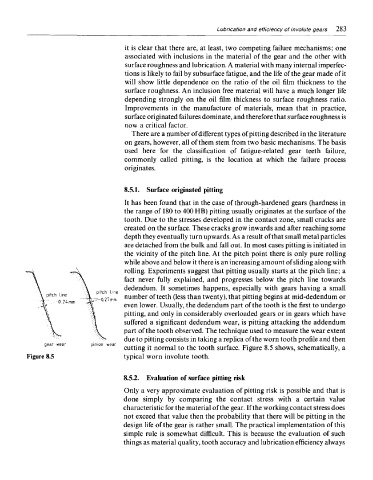
                                 part of the tooth observed. The technique used to measure the wear extent
                                 due to pitting consists in taking a replica of the worn tooth profile and then
                                 cutting it normal to the tooth surface. Figure 8.5 shows, schematically, a
     Figure 8.5                  typical worn involute tooth.

                                 8.5.2. Evaluation of surface pitting risk
                                 Only a very approximate evaluation of pitting risk is possible and that is
                                 done simply by comparing the contact stress with a certain value
                                characteristic for the material of the gear. If the working contact stress does
                                 not exceed that value then the probability that there will be pitting in the
                                 design life of the gear is rather small. The practical implementation of this
                                 simple rule is somewhat difficult. This is because the evaluation of such
                                things as material quality, tooth accuracy and lubrication efficiency always

