


Page 316 - Water Loss Control
P. 316
Contr olling Real Losses in the Field—Pr oactive Leak Detection     285


                        •  The configuration of the distribution network pump system and location of
                           pumping stations need to be carefully assessed and included in the design
                           stage.
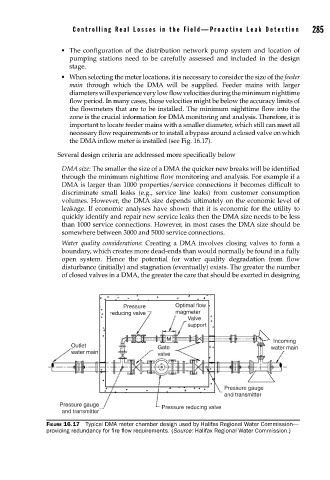
                        •  When selecting the meter locations, it is necessary to consider the size of the feeder
                           main through which the DMA will be supplied. Feeder mains with larger
                           diameters will experience very low flow velocities during the minimum nighttime
                           flow period. In many cases, those velocities might be below the accuracy limits of
                           the flowmeters that are to be installed. The minimum nighttime flow into the
                           zone is the crucial information for DMA monitoring and analysis. Therefore, it is
                           important to locate feeder mains with a smaller diameter, which still can meet all
                           necessary flow requirements or to install a bypass around a closed valve on which
                           the DMA inflow meter is installed (see Fig. 16.17).

                       Several design criteria are addressed more specifically below
                         DMA size: The smaller the size of a DMA the quicker new breaks will be identified
                         through the minimum nighttime flow monitoring and analysis. For example if a
                         DMA is larger than 1000 properties/service connections it becomes difficult to
                         discriminate small leaks (e.g., service line leaks) from customer consumption
                         volumes. However, the DMA size depends ultimately on the economic level of
                         leakage. If economic analyses have shown that it is economic for the utility to
                         quickly identify and repair new service leaks then the DMA size needs to be less
                         than 1000 service connections. However, in most cases the DMA size should be
                         somewhere between 3000 and 5000 service connections.
                         Water quality considerations: Creating a DMA involves closing valves to form a
                         boundary, which creates more dead-ends than would normally be found in a fully
                         open system. Hence the potential for water quality degradation from flow
                         disturbance (initially) and stagnation (eventually) exists. The greater the number
                         of closed valves in a DMA, the greater the care that should be exerted in designing


                                          Pressure       Optimal flow
                                      reducing valve     magmeter
                                                             Valve
                                                             support
                                                       M                             Incoming
                           Outlet                   Gate                             water main
                           water main               valve


                                                                       Pressure gauge
                                                                       and transmitter
                        Pressure gauge               Pressure reducing valve
                         and transmitter
                    FIGURE 16.17  Typical DMA meter chamber design used by Halifax Regional Water Commission—
                    providing redundancy for fi re fl ow requirements. (Source: Halifax Regional Water Commission.)

