


Page 333 - Introduction to Statistical Pattern Recognition
P. 333
7  Nonparametric Classification and Error Estimation         315


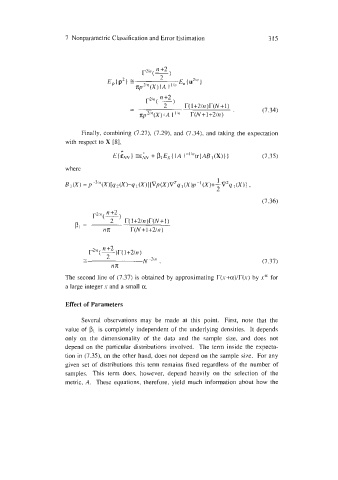
                          Finally, combining (7.27),  (7.29), and  (7.34),  and taking the expectation
                     with respect to X [SI,

                                   E{;NN~ EE~N -tP,E,(  IA  l-””tr{ABI(X)]}      (7.35)
                     where

                                                                   1
                                                        I
                                          1
                     B 1 (XI = P-*”’(X)[q*(x)-q (X)l[Vp(X)VTq (X)p-?x)+p2q 1 (X)] 1
                                                                                 (7.36)


                                n +2
                          -  r21n (-)r(   1 +2in )
                                 2
                          -                 N-2111                               (7.37)
                          -
                                   nn
                     The second line of  (7.37) is obtained by  approximating l-(x+a)lT(x) by  xa for
                     a large integer x and a small a.


                     Effect of Parameters

                          Several observations may  be  made  at  this  point.  First,  note  that  the
                     value of  PI is completely independent of  the underlying densities.  It depends
                     only  on  the  dimensionality  of  the  data  and  the  sample  size,  and  does  not
                     depend  on the particular distributions involved.  The term  inside the expecta-
                     tion in (7.33, on the other hand, does not depend on the sample size.  For any
                     given set of  distributions this term  remains fixed regardless of  the number of
                     samples.  This  term  does,  however,  depend  heavily  on  the  selection  of  the
                     metric, A.  These equations, therefore, yield  much  information about how  the

