


Page 336 - Introduction to Statistical Pattern Recognition
P. 336
318                        Introduction to Statistical Pattern Recognition


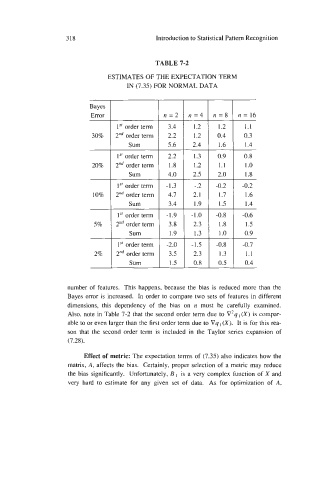
                                                TABLE 7-2

                                  ESTIMATES OF THE EXPECTATION TERM
                                        IN (7.35) FOR NORMAL DATA

                            Bayes
                             Error                                       n  = 16
                                    1''  order term   3.4                  1.1
                             30%    2"d order term   2.2                   0.3
                                        Sum         5.6                    1.4
                                    1''  order term   2.2   1.3    0.9     0.8
                             20%    2"d order term   1.8    1.2    1.1     1 .o
                                        Sum         4.0    2.5     2.0     1.8
                                     1''  order term   -1.3               -0.2
                             10%    2'ld order term   4.7                  1.6
                                        Sum         3.4                    1.4
                                     1''  order term   -1.9               -0.6
                             5%     2"d order term   3.8                   1.5
                                        Sum         1.9                    0.9
                                     1"  order term   -2.0   -1.5   -0.8   -0.7
                              2%    2'ld  order term   3.5   2.3           1.1
                                        Sum         1.5     0.8    0.5     0.4


                     number of  features.  This happens, because the bias  is  reduced more than  the
                     Bayes error is increased.  In order to compare two sets of  features in different
                     dimensions,  this  dependency  of  the  bias  on  n  must  be  carefully  examined.
                     Also, note in Table 7-2 that the second order term due to V2q,(X) is compar-
                     able to or even larger than the first order term due to Vq I (X).  It is for this rea-
                     son  that  the  second  order term  is  included  in  the  Taylor  series expansion  of
                     (7.28).
                          Effect of  metric:  The expectation terms of  (7.35) also indicates how the
                     matrix, A,  affects the bias.  Certainly, proper selection of  a metric may reduce
                      the bias significantly.  Unfortunately, BI is a very  complex function of  X  and
                     very  hard  to  estimate  for  any  given  set  of  data.  As  for  optimization  of  A,

