


Page 332 - Introduction to Statistical Pattern Recognition
P. 332
3 14                       Introduction to Statistical Pattern Recognition


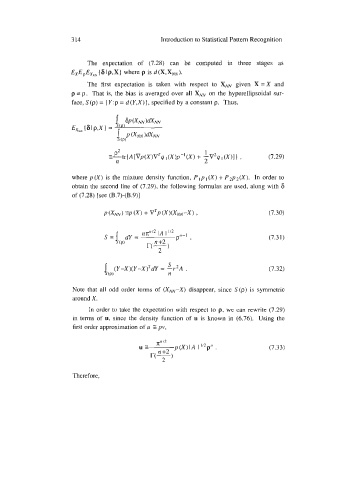
                            The  expectation  of  (7.28)  can  be  computed  in  three  stages  as
                       ExE,Ex,,(61p,X)  where p is d(X,XNN).
                            The  first  expectation  is  taken  with  respect  to  XNN given  X  = X  and
                       p = p.  That is, the bias is averaged over all XNN on  the hyperellipsoidal sur-
                       face, S (p) = ( Y :p = d (Y,X) ),  specified by  a constant p.  Thus,


                                         (xNN
                                     (p~p MXNN
                       Ex,(61P9X) =
                                         (xNNMxNN

                                                                                   (7.29)


                       where p(X) is the mixture density function, P 'p,(X) + P2p2(X). In order to
                       obtain the second line of (7.291,  the following formulas are used, along with 6
                       of  (7.28) [see (B.7)-(B.9)1


                                                                                   (7.3 1)


                                 I,,,               S                              (7.32)
                                    (Y-X)(Y-X)TdY  = -r2A  .
                                                    n

                       Note that all odd order terms of  (XNN-X) disappear, since S(p)  is  symmetric
                       around X.
                            In order to take the expectation with respect to p, we can rewrite (7.29)
                       in  terms of  u, since the density function of  u  is known  in  (6.76).  Using the
                       first order approximation of u  Z pv,

                                                           I
                                           UZ d"2     p (X) A I "*p" .             (7.33)
                                                 n +2
                                               UT)

                       Therefore,

