


Page 346 - Introduction to Statistical Pattern Recognition
P. 346
328                        Introduction to Statistical Pattern Recognition


                                E(%)
                               7.0 .f
                                        0 N=25                        9p
                                        0 N=50
                                        A N=100                    H
                                        X  N=200                   0
                               5.0


                                 0
                                                1 .o           2.0
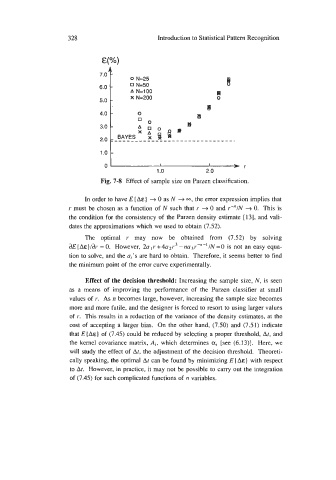
                               Fig. 7-8  Effect of sample size on Parzen classification.

                           In order to have E [A&} + 0 as N  + 00,  the error expression implies that
                      r  must  be  chosen as a function of  N  such that I'  + 0 and r-"/N + 0.  This is
                      the condition for the consistency of the Parzen density estimate [ 131, and vali-
                      dates the approximations which we used to obtain (7.52).
                           The  optimal  r  may  now  be  obtained  from  (7.52)  by  solving
                      aE { A&)/& = 0.  However, 2aI r +4a2r3 -na3r-"-'IN =O  is not an easy equa-
                      tion to solve, and the ai's are hard to obtain.  Therefore, it seems better to find
                      the minimum point of  the error curve experimentally.

                           Effect of the decision threshold: Increasing the sample size, N, is seen
                      as a  means  of  improving  the  performance of  the  Parzen  classifier at  small
                      values of r.  As n becomes large, however, increasing the sample size becomes
                      more and more futile, and the designer is forced to resort to using larger values
                      of  r.  This results in a reduction of  the variance of  the density estimates, at the
                      cost of  accepting a larger bias.  On  the  other hand, (7.50) and  (7.51) indicate
                      that E (A&] of (7.45)  could be reduced by  selecting a proper threshold, At, and
                      the kernel covariance matrix, A;, which determines a; [see (6.13)].  Here, we
                      will  study the effect of  At,  the adjustment of the decision threshold.  Theoreti-
                      cally speaking, the optimal At can be found by minimizing E (A&] with respect
                      to Ar.  However, in practice, it may not be possible to carry out the integration
                      of (7.45) for such complicated functions of n variables.

