


Page 351 - Introduction to Statistical Pattern Recognition
P. 351
7  Nonparametric Classification and Error Estimation          333


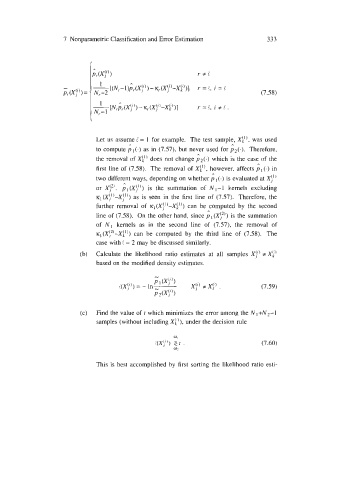
                              Let us assume e=  1 for example.  The test  sample, Xi!), was used
                                                                       II
                              to compute p  (.) as in (7.57), but never used for p2(.). Therefore,
                              the removal of Xi') does not change ;2(.)  which is the case of  the
                              first line of  (7.58). The removal of Xi1), however, affects   in
                              two different ways, depending on whether   (.) is evaluated at Xj')
                              or  Xy.  il(Xj")  is  the  summation  of  NI-1  kernels  excluding
                                          as
                              K~(X~')-X~')) seen  in  the  first line of  (7.57).  Therefore, the
                                            is
                              further removal of  K~(X~')-X~')) can  be  computed by  the  second
                              line of  (7.58).  On the other hand, since i I (X12)) is the summation
                              of  NI kernels  as  in  the  second  line  of  (7.57), the  removal  of
                              K~(X:~)-XZI)) can  be  computed by  the  third  line  of  (7.58).  The
                              case with E  = 2 may be discussed similarly.

                         (b)   Calculate the  likelihood  ratio  estimates at  all  samples Xy) # Xf)
                              based on the modified density estimates.


                                                                                (7.59)


                         (c)   Find the value oft which minimizes the error among the NI+N2-I
                              samples (without including Xf)), under the decision rule


                                                                                (7.60)


                              This is best  accomplished by  first sorting the  likelihood ratio esti-

