


Page 350 - Introduction to Statistical Pattern Recognition
P. 350
332                        Introduction to Statistical Pattern Recognition


                      This option makes no assumptions about the densities of  the data or the shape
                      of the kernel function.  However, since the value of the threshold is customized
                      to the data being tested, using this option will consistently bias the results low.
                      This is not objectionable in the case of R errors, since the R error is used as a
                      lower  bound  of  the  Bayes  error.  However,  using  this  procedure can  give
                      erroneous results for the L error.  Options 3 and 4 are designed to alleviate this
                      problem.

                      Oprion 3:  For each value of r, find the value of t which minimizes the R error,
                      and then use this value oft to find the L error.  Since the selection of  the thres-
                      hold has been  isolated from the actual values of  the L  estimates of  the likeli-
                      hood  ratio, using  this method does in  fact help reduce the bias encountered in
                      Option 2.  Experimental results will show that this method does give reliable
                      results as long as r  is relatively large.  When r  is small, however, the L esti-
                      mates of  the likelihood ratio are heavily biased as is seen in Fig. 7-9(b), and
                      use  of  these estimates to determine the threshold  may  give far from  optimal
                      results.  An  advantage of  this  option  is  that  it requires no more  computation
                      time than Option 2.


                      Option 4: Under this option, the R  error is found exactly as in  Option 2,  by
                      finding the value oft which minimizes the R error, and using this error rate.  In
                      order to find the L error, we use an L procedure to determine the value of  t to
                      use  for each sample.  Hence, under Option 4,  we  use  a different threshold to
                      test  each  of  the  Nl+N2  samples, determining the  threshold  for  each  sample
                      from the other NI+N2-I  samples in the design set.  The exact procedure is as
                      follows.
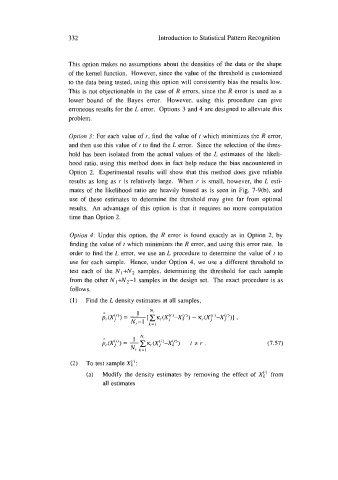
                      (1)   Find the L density estimates at all samples,


                                                           i#r                    (7.57)


                      (2)  To test sample Xf):
                           (a)   Modify the density estimates by  removing the effect of  Xf) from
                                all estimates

