


Page 352 - Introduction to Statistical Pattern Recognition
P. 352
334                        Introduction to Statistical Pattern Recognition


                                mates [(XY)), and then incrementing the value of  t through this list,
                                keeping track of the number of errors for each value oft.
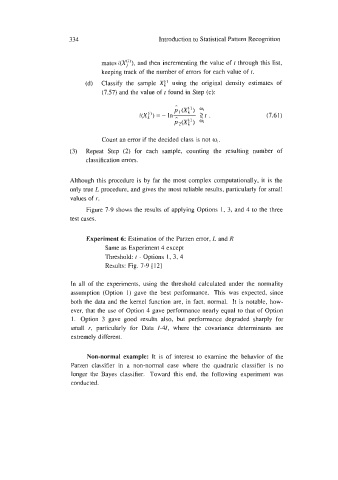
                           (d)   Classify  the  sample  Xf’  using  the  original  density  estimates  of
                                (7.57) and the value of r  found in Step (c):


                                                                                  (7.61)


                                Count an error if the decided class is not 0,.
                      (3)   Repeat  Step  (2)  for  each  sample,  counting  the  resulting  number  of
                           classification errors.


                      Although this procedure is by  far the most  complex computationally, it is the
                      only true L procedure, and gives the most reliable results, particularly for small
                      values of r.
                           Figure 7-9 shows the results of applying Options  1, 3, and 4 to the three
                      test cases.


                           Experiment 6:  Estimation of the Parzen error, L and R
                                 Same as Experiment 4 except
                                 Threshold: r - Options 1, 3, 4
                                 Results: Fig. 7-9 [ 121

                       In  all  of  the  experiments, using  the  threshold calculated  under  the  normality
                      assumption  (Option  1) gave  the  best  performance.  This  was  expected,  since
                      both the data and the kernel function are, in fact, normal.  It  is notable, how-
                       ever, that the use of  Option 4 gave performance nearly equal to that of Option
                       1.  Option  3  gave  good  results  also,  but  performance  degraded  sharply  for
                       small  I’, particularly  for  Data  1-41,  where  the  covariance  determinants  are
                       extremely different.


                           Non-normal  example:  It  is  of  interest to  examine  the  behavior of  the
                       Parzen  classifier  in  a  non-normal  case  where  the  quadratic  classifier  is  no
                       longer  the  Bayes  classifier.  Toward  this  end,  the  following  experiment  was
                       conducted.

