


Page 362 - Introduction to Statistical Pattern Recognition
P. 362
344                        Introduction to Statistical Pattern Recognition


                      approaches a  uniform  (hyperelliptical) kernel, always  with  a  smooth roll-off
                      (for finite m), and always with covariance r2Ai. Using this kernel allows us to
                      use kernel functions close to the uniform kernel, without having to worry about
                      the problem of equal density estimates.
                           Figure 7-12 shows the performance of  the Parzen estimates with  m = 1
                      (normal kernel), 2, and 4.

                           Experiment 11: Estimation of the Parzen error, L and R
                                 Same as Experiment 4 except
                                 Kernel: (6.3), m = 1, 2, 4
                                 Threshold: Option 4
                                 Results: Fig. 7-12 [12]

                      In all cases, using higher values of rn (more uniform-like kernel functions) does
                       improve the lower bound while having little effect on the upper bounds of the
                      error.


                      Estimation of the Bayes Error in the Parzen Approach

                           So far, we have discussed how to obtain the upper and lower bounds of
                      the Bayes error.  In this section, we address the estimation of  the Bayes error
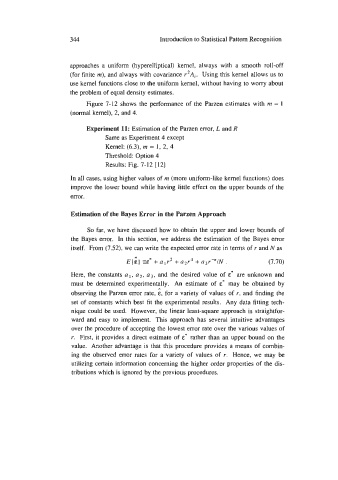
                       itself.  From (7.52), we can write the expected error rate in terms of r and N as

                                                                                  (7.70)
                       Here, the constants ul, u2, a3, and the desired value of  E*  are unknown  and
                       must  be  determined experimentally.  An  estimate of  E*  may  be  obtained by
                                                 A
                       observing the Parzen error rate, E, for a variety of  values of  r, and finding the
                       set of  constants which best fit the experimental results.  Any  data fitting tech-
                       nique could be used.  However, the linear least-square approach is straightfor-
                       ward  and easy to  implement.  This approach has several intuitive advantages
                       over the procedure of accepting the lowest error rate over the various values of
                       r.  First, it provides a direct estimate of E*  rather than an  upper bound on the
                       value.  Another advantage is that this procedure provides a means of combin-
                       ing the observed error rates for a variety of  values of  r.  Hence,  we may be
                       utilizing certain information concerning the higher order properties of the dis-
                       tributions which is ignored by the previous procedures.

