


Page 364 - Introduction to Statistical Pattern Recognition
P. 364
346                        Introduction to Statistical Pattern Recognition


                      is advisable  to evaluate  the  Parzen  classifier  for  a  variety  of  values of  f,  and
                      then apply the curve fit procedure for each value of  t.  This results in a negligi-
                      ble  increase  of  the  computational burden,  since the bulk  of  the  time  is  spent
                      calculating the density estimates, and  only a  very  small percentage comparing
                      the estimates to the thresholds.
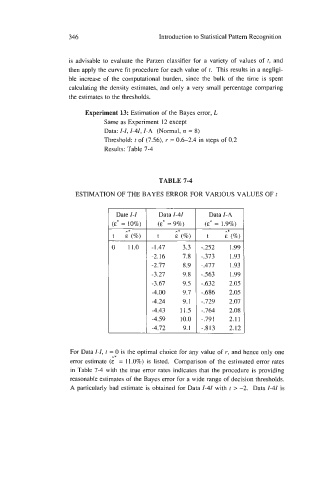
                           Experiment 13: Estimation  of the Bayes error, L
                                Same as Experiment 12 except
                                Data: 1-1, 1-41, I-A  (Normal, n = 8)
                                Threshold:  t of  (7.56), I'  = 0.6-2.4  in steps of  0.2
                                Results: Table 7-4


                                                 TABLE 7-4

                        ESTIMATION  OF THE BAYES ERROR FOR VARIOUS VALUES OF r


                                    Date I-I     Data 1-41      Data I-A
                                   (E*  = 10%)   (E*  = 9%)    (E*  = 1.9%)
                                   t  E*(%)     t     E*(%)    t     r*
                                                                     E  (%)
                                   0   11.0    - 1.47   3.3   -.252   1.99
                                               -2.16    7.8   -.373   1.93
                                               -2.77    8.9   -.477   1.93
                                               -3.27    9.8   -.563   1.99
                                               -3.67    9.5   -.632   2.05
                                               -4.00    9.7   -.686   2.05
                                               -4.24    9.1   -.729   2.07
                                               -4.43   11.5   -.764   2.08
                                               -4.59   10.0   -.791   2.1 1
                                               -4.72    9.1   -.813   2.12


                      For Data 1-1, t  = 0 is the optimal choice for any value of  r, and hence only one
                                   A*
                      error estimate  (E  = 11.0%) is  listed.  Comparison  of  the estimated error rates
                      in  Table 7-4 with  the  true error rates indicates that  the procedure is providing
                      reasonable estimates of the Bayes error for a wide range of  decision thresholds.
                      A particularly  bad  estimate  is obtained  for Data 1-41 with  t  > -2.  Data 1-41 is

