


Page 365 - Introduction to Statistical Pattern Recognition
P. 365
7  Nonparametric Classification and Error Estimation          347


                    the case in  which the covariance determinants of  the two classes are very  dif-
                    ferent.  Also,  it  is observed in  Fig.  7-7(b) that  the error  curve  increases very
                    quickly.  With t ranging from -3  to -5,  the error curve becomes more like the
                    one of Fig. 7-7(c), having a down-slope, a minimum at a higher I-, and a slower
                    up-slope.  This means that  smaller biases exist  in  a wider range of  I' and that
                    (7.70) fits the actual errors more accurately.


                    WN Approach

                         So far, we  have discussed error estimation based on the  Parzen  density
                    estimate.  Similarly, we can develop the argument using the kNN  density esti-
                    mation.  These two  approaches are  closely  related  in  all  aspects  of  the  error
                    estimation problem, and give similar results.  In this section, the kNN  approach
                    will be presented.  However, in order to avoid lengthy duplication, our discus-
                    sion will be limited.


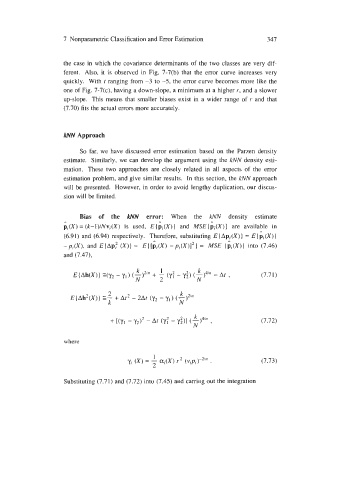
                         Bias  of  the  kNN  error:  When  the  kNN  density  estimate
                    f;i(X) = (k-l)/Nv;(X)  is  used,  E( pi(X)]  and  MSE { ii(X)]  are  available  in
                    (6.91) and (6.94) respectively.  Therefore, substituting E { Api(X) 1 = E { &(X) 1
                    -p;(X),  and  E{Ap? (X)) =  E{[pi(X) -pi(X)I2) =  MSE  {pj(X)] into  (7.46)
                    and (7.47),


                                                                                (7.71)


                                  2                     k
                      E(Ah2(X)] G-  + Ar2 - 2At  (y2 - y,)  (-)2'n
                                  k                    N

                                                                                (7.72)


                    where

                                                1
                                                                 .
                                        y;  (X) = - a;(X) r2 (v;p;)-2/"         (7.73)
                                               2
                    Substituting (7.71) and (7.72) into (7.45) and carring out the integration

