


Page 370 - Introduction to Statistical Pattern Recognition
P. 370
352                         Introduction to Statistical Pattern Recognition


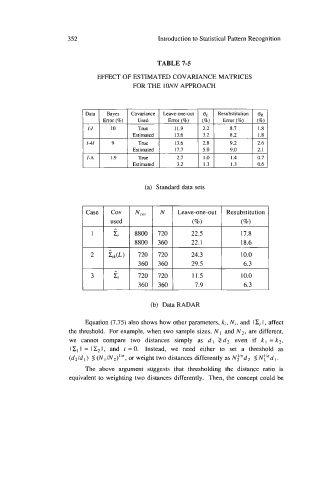
                                                TABLE 7-5

                              EFFECT OF ESTIMATED COVARIANCE MATRICES
                                         FOR THE lONN APPROACH


                           Data   Bayes   Covariance   Leave-one-out   a~  Resubstitution   oR
                                Error (%)   Used    Error(%)   (%)   Error(%)   (%)
                           I-I    IO      True       11.9     2.2     8.7      1.8
                                         Estimated   13.6     3.2     8.2      I .8
                           1-4     9      True       13.6     2.8     9.2     2.6
                                         Estimated   17.7     5.0     9.0     2. I
                           I-A    1.9     True        2.7     I .o    1.4     0.7
                                         Estimated    3.2     I .3    I .3    0.6


                                            (a)  Standard data sets


                           Case   Cov     N,,,.   N   Leave-one-out   Resubstitution
                                  used                     (%)           (%)
                            1      !&    8800   720       22.5           17.8
                                         8800   360       22.1           18.6
                            2    &(L)     720   720       24.3           10.0
                                          360   360       29.5            6.3
                            3      i;     720   720        11.5          10.0
                                          360   360         7.9           6.3


                                              (b)  Data RADAR

                          Equation (7.75) also shows how other parameters, k;, N;, and  I C; I, affect
                      the threshold.  For example, when  two sample sizes, N I  and N2, are different,
                      we  cannot  compare  two  distances  simply  as  dl ><d2 even  if  kl = k2,
                      ICI I = I C2 I,  and  t  = 0.  Instead,  we  need  either  to  set  a  threshold  as
                                        or
                      (d2Idl) 5 (N IIN2)1/n, weight two distances differently as N4'"d2 5 Nl/"dl.
                          The  above  argument  suggests  that  thresholding  the  distance  ratio  is
                      equivalent to weighting two distances differently.  Then, the concept could be

