


Page 371 - Introduction to Statistical Pattern Recognition
P. 371
7  Nonparametric Classification and Error Estimation         353


                     applied to  the  voting  kNN  approach  too.  If  we  adopt  aiA (a I  t u2) as  the
                     metric to measure the  distance to  mi-neighbors in the voting kNN  procedure,
                     we  can  control  the  decision  threshold by  adjusting  the  ratio  of  al and  a2.
                     Furthermore, using  aiAi (a I  t a2, A  # A2), we  could make  the  voting  kNN
                     virtually equivalent to the volumetric kNN.  In  this  case, Ai  could be  Zj or a
                     more complex matrix like  (7.65), and  the  ratio of  al and a2 still determines
                     the threshold.

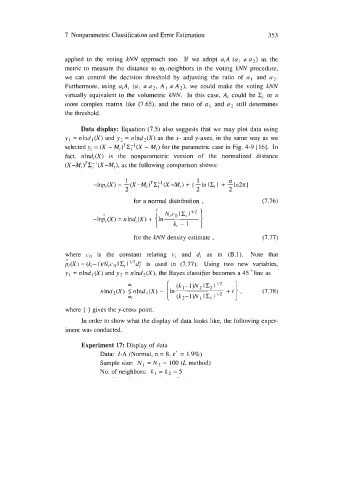
                          Data display: Equation (7.5) also suggests that we  may  plot data using
                     y I  = nlnd, (X) and y2 = nlnd2(X) as the x-  and y-axes, in the same way as we
                     selected y, = (X - Mj)*Z;'(X  - Mi) for the parametric case in Fig. 4-9 [ 161.  In
                     fact,  nlndi(X)  is  the  nonparametric  version  of  the  normalized  distance
                     (X-Mj)TC;l (X-M,),  as the following comparison shows:


                                       1                     1        n
                             -lnpj(x)  = -(x-M~)*z;'(x-M;)  + { -1n  IC, I + -1n2n:)
                                       2                     2        2
                                          for a normal distribution ,            (7.76)

                             -lnpj(X) = nlnd,(X) +   Nico I Zj I
                                A

                                          for the kNN density estimate ,         (7.77)

                     where  co  is  the  constant  relating  vi  and  d,  as  in  (B.1).  Note  that
                     &X) = (kj-l)/Nico I C, "2dl  is  used  in  (7.77).  Using  two  new  variables,
                                        I
                     y I  = nlndl (X) and y2 = nlnd2(X), the Bayes classifier becomes a 45 'line  as

                                nlnd2(X)  Snlndl(X) -                            (7.78)


                     where 1. ) gives the y-cross point.
                          In order to show what the display of data looks like, the following exper-
                     iment was conducted.

                          Experiment 17: Display of data
                               Data:  I-A (Normal, n = 8, E*  = 1.9%)
                               Sample size:  N I  = N2 = 100 (L method)
                               No.  of neighbors:  kl = k2 = 5

