


Page 363 - Introduction to Statistical Pattern Recognition
P. 363
7  Nonparametric Classification and Error Estimation          345


                         As mentioned earlier, it is reasonable to expect that all four of the con-
                    stants in  (7.70) are positive, since the observed error must remain above &*  for
                    any value of r.  In order to ensure stability in the estimate of E*, it is advisable
                    to restrict the constants to positive values during the curve fit procedure.
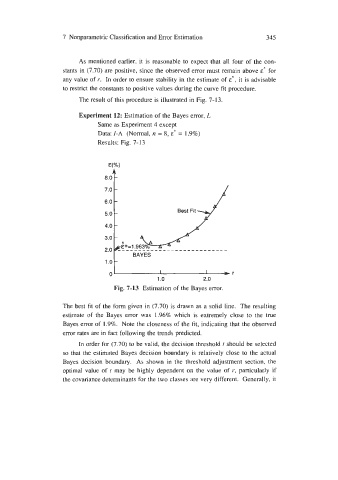
                         The result of  this procedure is illustrated in Fig. 7-13.

                         Experiment 12: Estimation of the Bayes error, L
                               Same as Experiment 4 except
                               Data: I-A  (Normal, n = 8, E* = 1.9%)
                               Results: Fig. 7-13


                                 1.01
                                  0’              I             I    )r
                                                 1 .o          2.0
                                    Fig. 7-13  Estimation of  the Bayes error.

                    The best fit of the form given in (7.70) is drawn as a solid line.  The resulting
                    estimate of  the  Bayes error was  1.96% which  is  extremely close to  the  true
                    Bayes error of  1.9%.  Note the closeness of the fit, indicating that the observed
                    error rates are in fact following the trends predicted.
                         In order for (7.70) to be valid, the decision threshold t should be  selected
                    so that the estimated Bayes decision boundary is relatively close to the actual
                    Bayes decision boundary.  As  shown in  the threshold adjustment section, the
                    optimal value of  t  may  be  highly dependent on  the  value of  I-, particularly if
                    the covariance determinants for the two classes are very different.  Generally, it

