


Page 379 - Introduction to Statistical Pattern Recognition
P. 379
7  Nonparametric Classification and Error Estimation         36 1


                     samples can  be  hierarchically decomposed to  subsets, sub-subsets and  so on
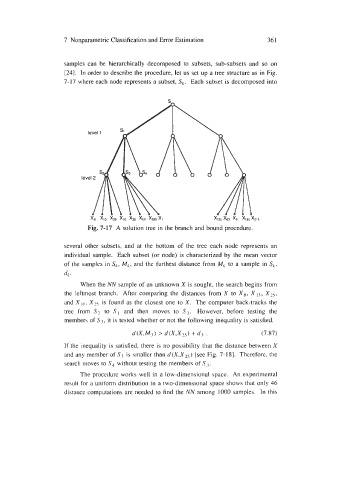
                     [24].  In order to describe the procedure, let us set up a tree structure as in Fig.
                     7-17 where each node represents a subset, Sk. Each subset is decomposed into


                            Fig. 7-17  A solution tree in the branch and bound procedure.


                     several other subsets, and  at  the  bottom  of  the  tree each  node  represents an
                     individual sample.  Each subset (or node) is characterized by  the mean vector
                     of  the samples in Sp, Mk, and the furthest distance from Mk to a sample in  Sk,
                     dk .
                         When the NN sample of an unknown X  is sought, the search begins from
                     the  leftmost branch.  After comparing the distances from X  to X8, XI3, X,,,
                     and Xl0, X2s is  found as the  closest one to X.  The computer back-tracks the
                     tree  from  S2  to  SI and  then  moves  to  S3.  However,  before  testing  the
                     members of S3, it is tested whether or not the following inequality is satisfied.

                                         d(X,Mx) > d(X.Xz5) + d3  .              (7.87)
                     If the  inequality is satisfied, there is no possibility that the distance between X
                     and any member of S3 is smaller than d(X,Xl5) [see Fig. 7-18].  Therefore, the
                     search moves to S4 without testing the members of S3.
                          The procedure works well in  a low-dimensional space.  An experimental
                     result for a uniform distribution in a two-dimensional space shows that only 46
                     distance computations are needed to find the NN among  1000 samples.  In this

