


Page 471 - The ISA Handbook in Contemporary Sociology
P. 471
9781412934633-Chap-29  1/12/09  4:20 PM  Page 442


                   442               THE ISA HANDBOOK IN CONTEMPORARY SOCIOLOGY


                   of its immigrants. 20  Québec even obtained   origin in particular locations tends to be
                   a substantially higher share of federal settle-  self-reinforcing, this is likely to be a long-
                   ment funds, based on the recognition, stated  term trend (McDonald, 2004).
                   in the agreement, that it needs additional  At the same time, immigration to Québec
                   resources to help immigrants integrate in a  has been consistently more modest than to
                   manner that takes into account its distinct  other large provinces. As Figure 29.1 illus-
                   identity (Li, 2003: 170). The key period in  trates, Québec has never reached a share of
                   this process was the second part of the 1970s,  new immigrants proportional to its demo-
                   when the Parti Québécois secured important  graphic weight in Canada (whereas Ontario
                   immigration powers in 1978 (under the   consistently exceeds it). But compared to
                   Cullen-Couture agreement), 21  and also  other developed countries around the world,
                   attempted to direct immigrants towards the  even major immigration destinations like the
                   provincial linguistic majority by making  United States, France, and Germany, Québec
                   French education mandatory for school-aged  ranks as a major immigrant-receiving society
                   newcomers.                              (see Figure 29.2).
                     The bifurcation of Canada’s immigration  These figures illustrate both the success
                   policy is therefore largely the product of  Québec has had at shaping its migratory
                   Québec’s efforts at greater policy autonomy,  influx and the continuing ambivalence with
                   with the objectives of protecting and devel-  which it approaches it.  This ambivalence
                   oping the use of French, and countering  goes beyond numbers, and is further illus-
                   demographic decline. Contemporary migra-  trated by the fluctuating mission (and name)
                   tion to Canada is, as a result, linguistically  of the ministry in charge of immigration
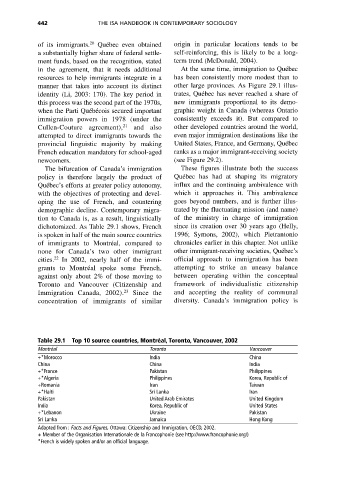
                   dichotomized. As Table 29.1 shows, French  since its creation over 30 years ago (Helly,
                   is spoken in half of the main source countries  1996; Symons, 2002), which Pietrantonio
                   of immigrants to Montréal, compared to  chronicles earlier in this chapter. Not unlike
                   none for Canada’s two other immigrant   other immigrant-receiving societies, Québec’s
                   cities. 22  In 2002, nearly half of the immi-  official approach to immigration has been
                   grants to Montréal spoke some French,   attempting to strike an uneasy balance
                   against only about 2% of those moving to  between operating within the conceptual
                   Toronto and  Vancouver (Citizenship and  framework of individualistic citizenship
                   Immigration Canada, 2002). 23  Since the   and accepting the reality of communal
                   concentration of immigrants of similar   diversity. Canada’s immigration policy is


                   Table 29.1  Top 10 source countries, Montréal, Toronto, Vancouver, 2002
                   Montréal                         Toronto                      Vancouver
                   +*Morocco                        India                        China
                   China                            China                        India
                   +*France                         Pakistan                     Philippines
                   +*Algeria                        Philippines                  Korea, Republic of
                   +Romania                         Iran                         Taiwan
                   +*Haiti                          Sri Lanka                    Iran
                   Pakistan                         United Arab Emirates         United Kingdom
                   India                            Korea, Republic of           United States
                   +*Lebanon                        Ukraine                      Pakistan
                   Sri Lanka                        Jamaica                      Hong Kong
                   Adapted from : Facts and Figures, Ottawa: Citizenship and Immigration, OECD, 2002.
                   + Member of the Organisation Internationale de la Francophonie (see http://www.francophonie.org/)
                   *French is widely spoken and/or an official language.

