


Page 472 - The ISA Handbook in Contemporary Sociology
P. 472
9781412934633-Chap-29  1/12/09  4:20 PM  Page 443


                                         CONFLICT AND DIVERSITY: CANADA / QUÉBEC             443


                           30

                           25

                           20
                                                                            Quebec Immig %
                           15
                                                                            Quebec Pop %
                           10

                            5

                            0
                                 1970       1980       1990      2000
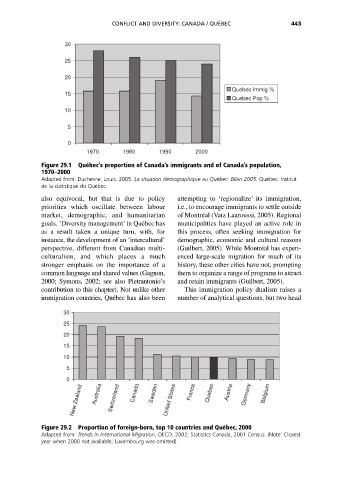
                    Figure 29.1  Québec’s proportion of Canada’s immigrants and of Canada’s population,
                    1970–2000
                    Adapted from: Duchesne, Louis. 2005. La situation démographique au Québec. Bilan 2005. Québec: Institut
                    de la statistique du Québec.
                    also equivocal, but that is due to policy   attempting to ‘regionalize’ its immigration,
                    priorities which oscillate between labour  i.e., to encourage immigrants to settle outside
                    market, demographic, and humanitarian   of Montréal (Vatz Laaroussi, 2005). Regional
                    goals. ‘Diversity management’in Québec has  municipalities have played an active role in
                    as a result taken a unique turn, with, for  this process, often seeking immigration for
                    instance, the development of an ‘intercultural’  demographic, economic and cultural reasons
                    perspective, different from Canadian multi-  (Guilbert, 2005). While Montréal has experi-
                    culturalism, and which places a much    enced large-scale migration for much of its
                    stronger emphasis on the importance of a  history, these other cities have not, prompting
                    common language and shared values (Gagnon,  them to organize a range of programs to attract
                    2000; Symons, 2002; see also Pietrantonio’s  and retain immigrants (Guilbert, 2005).
                    contribution to this chapter). Not unlike other  This immigration policy dualism raises a
                    immigration countries, Québec has also been  number of analytical questions, but two head

                           30
                           25
                           20
                           15
                           10
                            5
                            0
                              New Zealand  Australia  Switzerland  Canada  Sweden  United States  France  Quebec  Austria  Germany  Belgium


                    Figure 29.2  Proportion of foreign-born, top 10 countries and Québec, 2000
                    Adapted from: Trends in International Migration, OECD, 2002; Statistics Canada, 2001 Census. (Note: Closest
                    year when 2000 not available; Luxembourg was omitted).

