


Page 256 - A First Course In Stochastic Models
P. 256
POLICY-ITERATION ALGORITHM                   249

                                                         ∗
                unit. It is stated without proof that the function υ , i ∈ I, in (6.4.3) is uniquely
                                                         i
                determined up to an additive constant.
                  Next the policy-iteration algorithm is applied to compute an average cost optimal
                policy for the control problem in Example 6.1.1.
                Example 6.1.1 (continued) A maintenance problem

                It is assumed that the number of possible working conditions equals N = 5. The
                repair costs are given by C f = 10, C p2 = 7, C p3 = 7 and C p4 = 5. The deteri-
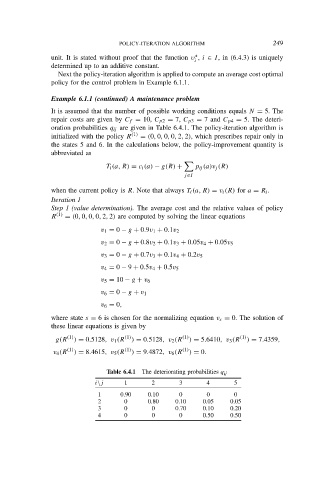
                oration probabilities q ij are given in Table 6.4.1. The policy-iteration algorithm is
                initialized with the policy R (1)  = (0, 0, 0, 0, 2, 2), which prescribes repair only in
                the states 5 and 6. In the calculations below, the policy-improvement quantity is
                abbreviated as

                                T i (a, R) = c i (a) − g(R) +  p ij (a)v j (R)
                                                      j∈I

                when the current policy is R. Note that always T i (a, R) = v i (R) for a = R i .
                Iteration 1
                Step 1 (value determination). The average cost and the relative values of policy
                R (1)  = (0, 0, 0, 0, 2, 2) are computed by solving the linear equations

                              v 1 = 0 − g + 0.9v 1 + 0.1v 2

                              v 2 = 0 − g + 0.8v 2 + 0.1v 3 + 0.05v 4 + 0.05v 5
                              v 3 = 0 − g + 0.7v 3 + 0.1v 4 + 0.2v 5
                              v 4 = 0 − 9 + 0.5v 4 + 0.5v 5
                              v 5 = 10 − g + v 6
                              v 6 = 0 − g + v 1
                              v 6 = 0,

                where state s = 6 is chosen for the normalizing equation v s = 0. The solution of
                these linear equations is given by
                    (1)              (1)              (1)             (1)
                 g(R  ) = 0.5128, v 1 (R  ) = 0.5128, v 2 (R  ) = 5.6410, v 3 (R  ) = 7.4359,
                    (1)              (1)              (1)
                v 4 (R  ) = 8.4615, v 5 (R  ) = 9.4872, v 6 (R  ) = 0.


                                Table 6.4.1 The deteriorating probabilities q ij
                            i\j      1       2       3       4       5
                             1      0.90    0.10     0       0       0
                             2       0      0.80    0.10    0.05   0.05
                             3       0       0      0.70    0.10   0.20
                             4       0       0       0      0.50   0.50

