


Page 133 - Advanced Gas Turbine Cycles
P. 133
Chapter 6. ‘Wet’ gas turbine plants          105

       6.6.  Some detailed parametric studies of wet cycles

         The  general  thermodynamic  conclusions  given  above  are  confirmed  by  more
       detailed parametric  studies which  have been  made by  several authors of  various wet
       cycles.
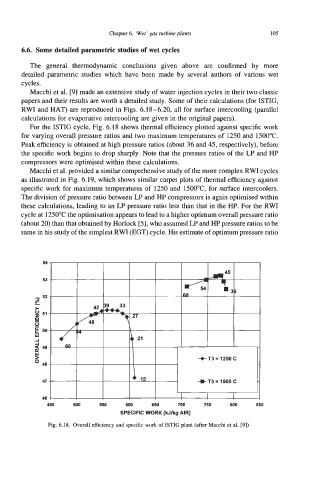
         Macchi et al. [9] made an extensive study of water injection cycles in their two classic
       papers and their results are worth a detailed study. Some of their calculations (for ISTIG,
       RWI and HAT) are reproduced in Figs. 6.18-6.20,  all for surface intercooling (parallel
       calculations for evaporative intercooling are given in the original papers).
         For the ISTIG cycle, Fig. 6.18  shows thermal efficiency plotted against specific work
       for varying overall pressure ratios and two maximum temperatures of  1250 and 1500°C.
       Peak efficiency is obtained at high pressure ratios (about 36 and 45, respectively), before
       the specific work begins to drop sharply. Note that the pressure ratios of the LP and HP
       compressors were optimised within these calculations.
         Macchi et al. provided a similar comprehensive study of the more complex RWI cycles
       as illustrated in Fig. 6.19,  which shows similar carpet plots of thermal efficiency against
       specific work for maximum temperatures of  1250 and  150O0C, for surface intercoolers.
       The division of pressure ratio between LP and HP compressors is again optimised within
       these calculations, leading to an LP pressure ratio less than that in the HP. For the RWI
       cycle at 1250°C the optimisation appears to lead to a higher optimum overall pressure ratio
       (about 20) than that obtained by Horlock [5], who assumed LP and HP pressure ratios to be
       same in his study of the simplest RWI (EGT) cycle. His estimate of optimum pressure ratio


             54

             53

             52
           E
           *
           y  51
           !!!
           $50
           W
           A
           J 49

           O48
             47


             46
              450     500    550    600     650    700    750     800    850
                                   SPECIFIC WORK [kJlkg AIR]
              Fig. 6.18.  Overall efficiency and specific work of ISTIG plant (after Macchi et al. A).

