


Page 132 - Advanced Gas Turbine Cycles
P. 132
200     300     400      500     600      700     no0     900
                                          SPECIFIC WORK
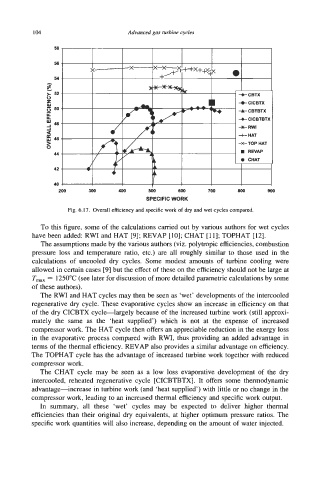
                    Fig. 6.17.  Overall efficiency and specific work of dry and wet cycles compared.

            To this figure, some of  the calculations carried out by various authors for wet cycles
          have been added: RWI and HAT [9]; REVAP [lo]; CHAT [ll]; TOPHAT [12].
            The assumptions made by the various authors (viz. polytropic efficiencies, combustion
          pressure loss  and  temperature ratio, etc.)  are all roughly similar to  those used  in  the
          calculations  of  uncooled dry  cycles.  Some  modest  amounts of  turbine  cooling  were
          allowed in certain cases [9] but the effect of these on the efficiency should not be large at
          T,,,  = 1250°C (see later for discussion of more detailed parametric calculations by some
          of these authors).
            The RWI and HAT cycles may then be seen as ‘wet’ developments of the intercooled
          regenerative dry cycle. These evaporative cycles show an increase in efficiency on that
          of the dry CICBTX cycle-largely  because of the increased turbine work (still approxi-
          mately  the  same  as the  ‘heat  supplied’)  which  is  not  at  the  expense  of  increased
          compressor work. The HAT cycle then offers an appreciable reduction in the exergy loss
          in  the evaporative process compared with RWI, thus providing an added advantage in
          terms of  the thermal efficiency. REVAP also provides a similar advantage on efficiency.
          The TOPHAT cycle has the advantage of  increased turbine work together with reduced
          compressor work.
            The CHAT cycle may  be  seen as  a  low  loss evaporative development of  the  dry
          intercooled, reheated regenerative cycle  [CICBTBTX]. It  offers some thermodynamic
          advantage-increase  in turbine work (and ‘heat supplied’) with little or no change in the
          compressor work, leading to an increased thermal efficiency and specific work output.
            In  summary,  all  these  ‘wet’  cycles  may  be  expected  to  deliver  higher  thermal
          efficiencies than their original dry equivalents, at higher optimum pressure ratios. The
          specific work quantities will also increase, depending on the amount of water injected.

