


Page 173 - Advanced Gas Turbine Cycles
P. 173
Chapter 8. Novel gas turbine cycles           I39

      from the last drum; carbon dioxide is collected from the other drums and compressed and
      intercooled for final discharge.
         Manfrida [4] argues that the heat demand and the substantial power loss associated with
       ‘presssure-swing’ physical absorption makes it less attractive than chemical absorption,
      even for high pressure sequestration. The expansion work  in  the former is difficult to
      recover as several expanders are needed.


      8.4.  Semi-closure

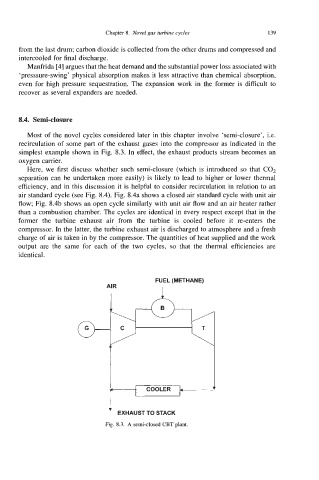
         Most of the novel cycles considered later in this chapter involve ‘semi-closure’, Le.
      recirculation of some part of the exhaust gases into the compressor as indicated in the
      simplest example shown in Fig. 8.3. In effect, the exhaust products stream becomes an
      oxygen carrier.
         Here, we  first discuss whether such  semi-closure (which is introduced so that CO2
      separation can be  undertaken more easily) is likely to lead to higher or lower thermal
      efficiency, and in this discussion it is helpful to consider recirculation in relation to an
      air standard cycle (see Fig. 8.4). Fig. 8.4a shows a closed air standard cycle with unit air
      flow; Fig. 8.4b shows an open cycle similarly with unit air flow and an air heater rather
      than a combustion chamber. The cycles are identical in every respect except that in the
      former  the  turbine  exhaust  air  from  the  turbine  is  cooled  before  it  re-enters  the
      compressor. In the latter, the turbine exhaust air is discharged to atmosphere and a fresh
      charge of air is taken in by the compressor. The quantities of heat supplied and the work
      output  are  the  same for  each  of  the  two  cycles,  so  that  the  thermal efficiencies are
      identical.


                                             FUEL (METHANE)
                               AIR             I


                                1

                                          COOLER

                                             STACK
                                          TO
                                  EXHAUST
                               Fig. 8.3. A semi-closed CBT plant.

