


Page 176 - Advanced Gas Turbine Cycles
P. 176
I42                       Advanced gas turbine cycles

          the ‘heating value’ of the fuel before it is burnt in the combustion chamber. This does not
          necessarily mean that the calorific value is increased, but that the mass of the new fuel
          (syngas) may be increased so that the overall ‘heating value’ is also increased.
             For the steam-TCR process, within a so-called  ‘Van’t Hoff  box’ containing the total
          reaction process (Fig. 8.5b). there are two stages:
               A :  CH4 + H20 w CO + 3H2;
          and

               B:  CO+H20*CO2+H2.
          The so-called Boudouard reaction involving solid carbon is ignored here.
             Stage A,  the steam reforming reaction, is highly endothermic and  stage B, usually
          known  as the  water gas shift reaction, is exothermic, so the overall reaction  (A + B)
          requires heat to be  supplied. If  this overall reaction is in equilibrium then the resulting
          mixture is made up of  carbon monoxide, carbon dioxide, hydrogen, water vapour and
          remaining methane. Thus, if a moles of methane are converted (per mole supplied), and P
          moles of hydrogen are formed then the overall reaction may be written as
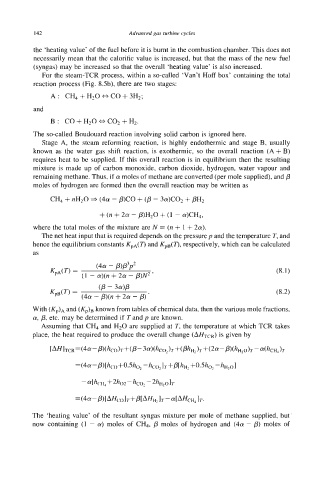
               CH4 + nH2O * (4a - P)CO + (P - 3a)C02 + PH2

                             + (n + 2a - P)H20 + (1 - a)CH4,
          where the total moles of the mixture are N  = (n + 1 + 2a).
             The net heat input that is required depends on the pressurep and the temperature T, and
          hence the equilibrium constants KPA(T) and KPB(T), respectively, which can be calculated
          as


          With (&)A  and (K,), known from tables of chemical data, then the various mole fractions,
          a, P, etc. may be determined if T and p  are known.
             Assuming that C&  and H20 are supplied at T,  the temperature at which TCR takes
          place, the heat required to produce the overall change (AHTCR) is given by

                      =(4a-
                                                                         -
                                                         )T
                                                                                >T
               [WTCR P)(hco )T + (P- 3 a)(hco, )T + (P~H, +@a- P)(~H~o)T Q(~CH~
                      =(4Q-P)[hco+O.5ho2  -k02 IT+PihHz  +0*5hO, -hHzOl


          The  ‘heating value’ of the resultant syngas mixture per mole of  methane supplied, but
          now  containing (1  - a) moles of  C&,  /3  moles of  hydrogen and  (4a - P) moles of

