


Page 174 - Advanced Gas Turbine Cycles
P. 174
Advanced gas turbine cycles


                                             +      pjq

                        CLOSED        T                      CYCLE
                        CYCLE
               IL
                        COOLER          v
                                              A


                                   3,
                                    \ SEMI-CLOSED  ’+
                                           CYCLE           T

                                              COOLER         1r
                                                             +

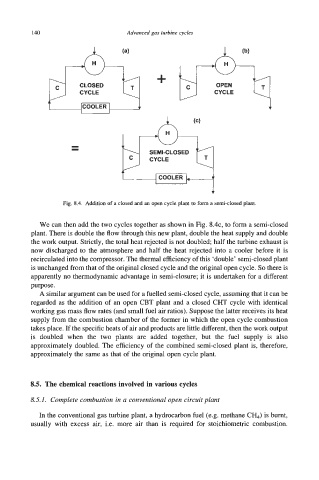
                   Fig. 8.4.  Addition of  a closed and an open cycle plant to form a semiclosed plant.


            We can then add the two cycles together as shown in Fig. SAC, to form a semi-closed
          plant. There is double the flow through this new plant, double the heat supply and double
          the work output. Strictly, the total heat rejected is not doubled; half the turbine exhaust is
          now discharged to the atmosphere and half  the heat rejected into a cooler before it is
          recirculated into the compressor. The thermal efficiency of this ‘double’ semi-closed plant
          is unchanged from that of the original closed cycle and the original open cycle. So there is
          apparently no thermodynamic advantage in semi-closure; it is undertaken for a different
          purpose.
            A similar argument can be used for a fuelled semi-closed cycle, assuming that it can be
          regarded as the addition of  an open CBT plant and a closed CHT cycle with identical
          working gas mass flow rates (and small fuel air ratios). Suppose the latter receives its heat
          supply from the combustion chamber of the former in which the open cycle combustion
          takes place. If the specific heats of air and products are little different, then the work output
          is  doubled  when  the  two  plants  are  added  together,  but  the  fuel  supply  is  also
          approximately doubled. The efficiency of the combined semi-closed plant is, therefore,
          approximately the same as that of the original open cycle plant.


          8.5.  The chemical reactions involved in various cycles

          8.5.1. Complete combustion in a conventional open circuit plans
            In the conventional gas turbine plant, a hydrocarbon fuel (e.g. methane CI&) is burnt,
          usually  with  excess  air,  i.e.  more  air than  is required for  stoichiometric combustion.

