


Page 175 - Advanced Gas Turbine Cycles
P. 175
Chapter 8.  Novel gas turbine cycles          141


                                        COYBUSTlON

                                7.52 N,


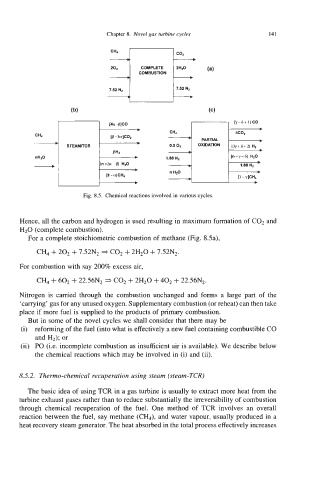
                         Fig. 8.5. Chemical reactions involved in various cycles.


       Hence, all the carbon and hydrogen is used resulting in maximum formation of C02 and
       H20 (complete combustion).
         For a complete stoichiometric combustion of methane (Fig. Ma),

           Cb  + 202 + 7.52N2 * C02 + 2H20 + 7.52N2.
       For combustion with say 200% excess air,

           CH4 + 602 + 22.56N2 * C02 + 2H20 + 402 + 22.56N2.
       Nitrogen  is carried  through the  combustion unchanged and  forms a  large part  of  the
       ‘carrying’ gas for any unused oxygen. Supplementary combustion (or reheat) can then take
       place if  more fuel is supplied to the products of primary combustion.
         But in some of the novel cycles we shall consider that there may be
       (i)  reforming of the fuel (into what is effectively a new fuel containing combustible CO
           and H2); or
       (ii)  PO (i.e. incomplete combustion as insufficient air is available). We describe below
           the chemical reactions which may be involved in (i) and (ii).

       8.5.2.  Thermo-chemical recuperation using steam (steam-TCR)

         The basic idea of using TCR in a gas turbine is usually to extract more heat from the
       turbine exhaust gases rather than to reduce substantially the irreversibility of combustion
      through  chemical  recuperation of  the  fuel.  One  method  of  TCR  involves an  overall
      reaction between the fuel, say methane (Ch), and water vapour, usually produced in a
       heat recovery steam generator. The heat absorbed in the total process effectively increases

