


Page 180 - Advanced Gas Turbine Cycles
P. 180
146                        Advanced gas turbine cycles

                                                   FUEL (METHANE)
                                                         1

                                                            \


                     ABSORPTION,
                     STRIPPING,
                     ILIQUEFACTION  rAJ HEAT EXCHANGER
                                  HEAT~N
                           1
                      LIQUID COz

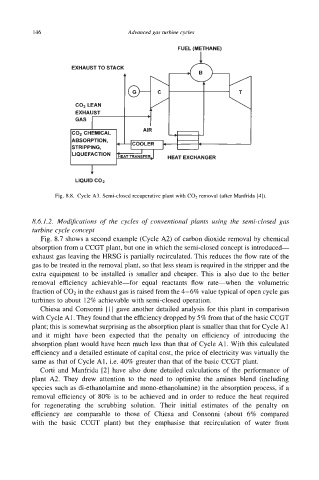
                 Fig. 8.8.  Cycle A3. Semi-closed recuperative plant with COz removal (after  hkdnfrida 141).


          8.6. I .2.  Mod$cations  of the  cycles  of  conventional plants  using  the  semi-closed gas
          turbine cycle concept
             Fig. 8.7  shows a second example (Cycle A2) of carbon dioxide removal by chemical
          absorption from a CCGT plant, but one in which the semi-closed concept is introduced-
          exhaust gas leaving the HRSG is partially recirculated. This reduces the flow rate of the
          gas to be treated in the removal plant, so that less steam is required in the stripper and the
          extra equipment to be  installed is  smaller and  cheaper. This is  also due to the better
          removal  efficiency  achievable-for   equal  reactants  flow  rate-when   the  volumetric
          fraction of C02 in the exhaust gas is raised from the 4-6%  value typical of open cycle gas
          turbines to about 12% achievable with semi-closed operation.
            Chiesa and Consonni [I]  gave another detailed analysis for this plant in comparison
          with Cycle AI. They found that the efficiency dropped by 5% from that of the basic CCGT
          plant; this is somewhat surprising as the absorption plant is smaller than that for Cycle A1
          and  it  might  have  been  expected  that  the  penalty  on  efficiency  of  introducing the
          absorption plant would have been much less than that of Cycle Al. With this calculated
          efficiency and a detailed estimate of capital cost, the price of electricity was virtually the
          same as that of Cycle Al, Le. 40% greater than that of the basic CCGT plant.
            Corti and  Manfrida [2] have also done detailed calculations of  the performance of
          plant  A2.  They  drew  attention  to  the  need  to  optimise  the  amines  blend  (including
          species such as di-ethanolamine and mono-ethanolamine) in the absorption process, if a
          removal efficiency of  80% is to be  achieved and  in order to reduce the heat required
          for  regenerating  the  scrubbing  solution.  Their  initial  estimates  of  the  penalty  on
          efficiency  are  comparable  to  those  of  Chiesa  and  Consonni  (about  6%  compared
          with  the  basic  CCGT  plant)  but  they  emphasise  that  recirculation  of  water  from

