


Page 181 - Advanced Gas Turbine Cycles
P. 181
Chapter 8.  Novel gas turbine cycles         I47

       the  scrubbing process  to  intercool  and  aftercool the  compression in  the  gas  turbine
       cycle  can  restore  about  half  the  loss  in  thermal  efficiency.  After  a  very  careful
       optimisation, and  by  including amine regeneration, Corti  and  Manfrida estimated the
       cost of  electricity generated by  this plant,  including COz  disposal, to be  about 4.7 c/
       kWh. This is slightly less than  the estimate of  Chiesa and  Consonni who based  their
       calculations on different sources.
          Fig.  8.8 shows yet another example (Cycle A3) of  the use of the semi-closed cycle
       concept, suggested by Manfrida [4], in which a recuperative CBTX plant is modified. Now
       the exhaust gas from the gas turbine is cooled in a heat exchanger (rather than the HRSG of
       a  CCGT  plant).  It  then  enters  the  chemical  absorption  plant  where  some  C02 is
       sequestrated and liquefied before disposal. The remainder of the exhaust gas is recirculated
       into compressor inlet after additional cooling. Manfrida finds slightly lower efficiency in
       the plant A3 compared with plant A2, but  argues that it may prove simpler and more
       economic than the semi-closed IGCC plant.


       8.6.2. Cycles B with modijication of  the fuel in combustion through thermo-chemical
       recuperation [TCR]
         We consider next the cycles B of Table 8.1B and the associated Figs. 8.9-8.12;  these
       cycles involve modification of the fuel used in the combustion process by TCR. There are
       two basic types of chemically recuperated gas turbine (CRGT) cycle:
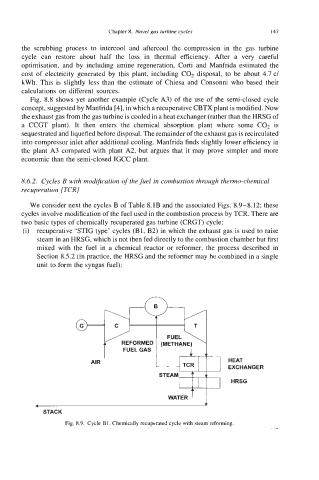
        (i)  recuperative ‘STIG type’ cycles (Bl, B2) in which the exhaust gas is used to raise
            steam in an HRSG, which is not then fed directly to the combustion chamber but first
            mixed  with  the  fuel  in  a chemical reactor or reformer, the  process described in
            Section 8.5.2 (in practice, the HRSG and the reformer may be combined in a single
           unit to form the syngas fuel);


                                                FUEL \

                               I              (METHANE)

                           AIR      FUELGAS                      HEAT
                                                           1 EXCHANGER
                                                           I
                                                                  HRSG


           -                                    WATER
             STACK
                   Fig. 8.9. Cycle B1. Chemically recuperated cycle with steam reforming.

