


Page 186 - Advanced Gas Turbine Cycles
P. 186
I52                        Advanced gas turbine cycles

          compared with 50MJkg for methane itself, but of  course there is now an even larger
          flow of  combustible gas that goes to the combustor so the  ‘heating value’ is  slightly
          increased.
            In another example Newby et al. [6] calculated a cycle with the reformer operating at
          comparable pressure and temperature but with a higher recycling rate of 1.7, leading to a
          conversion rate of  a = 0.56 (this is closer to the conversion rate of Lloyd’s steam/TCR
          cycle, a = 0.373, described in the last section). A thermal efficiency of 38.7% is claimed
          for this FG/TCR cycle, slightly greater than the simple CBT cycle efficiency of 35.7% but
          much  less  than  the  calculated  efficiency  for  the  steam/TCR  cycle  (48.7%) and  a
          comparable STIG cycle (45.6%).
            Clearly, these figures suggest that the plant is very sensitive to the amount of flue gas
          recycled. There appears to be no full parametric or economic calculation published in the
          literature for this FG/TCR cycle, which suggests that it has not been considered as an
          attractive option.


          8.6.3. Cycles C burning non-carbon fuel (hydrogen)

            Obviously, use of a non-carbon fuel-usually  containing hydrogen4bviates the need
          for any carbon dioxide extraction and disposal. These cycles are listed in Table 8. lC, and
          the associated Figs. 8.15-8.17.
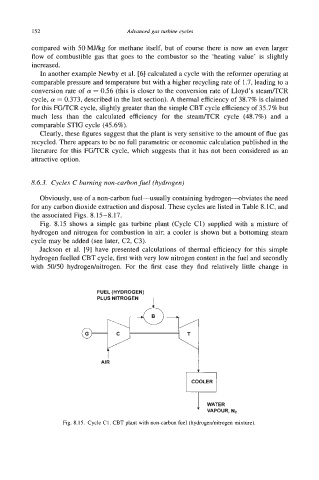
            Fig.  8.15  shows a  simple gas turbine plant (Cycle C1) supplied with  a mixture of
          hydrogen and nitrogen for combustion in air; a cooler is shown but a bottoming steam
          cycle may be added (see later, C2, C3).
            Jackson et  al.  [9] have presented calculations of  thermal efficiency for this  simple
          hydrogen fuelled CBT cycle, first with very low nitrogen content in the fuel and secondly
          with  50/50 hydrogednitrogen.  For  the  first  case  they  find  relatively  little  change  in


                            FUEL (HYDROGEN)
                                          A
                            PLUS NITROGEN


                              AIR


                                                       COOLER


                                                           WATER
                                                           VAPOUR, N2
                   Fig. 8.15. Cycle C1. CBT plant with non-carbon fuel (hydrogednitrogen mixture).

