


Page 183 - Advanced Gas Turbine Cycles
P. 183
Chapter 8.  Novel gas turbine cycles          149


              41 -


        (ii)  a  semi-closed cycle  (B3) in  which  part of  the exhaust gas is recirculated to the
            reformer, together with  the fuel  supply, to form a  new  syngas fuel  (the process
            described in Section 8.5.4).
          In  both  cases  heat  is  taken  from  the  exhaust gases to  ‘feed’ the  reaction process,
        enhancing the  ‘heating value’ of  the resulting modified fuel, which is then fed to the
        combustion chamber. But the main thermodynamic feature is that the exergy loss in the
        final exhaust gas is thus reduced and the efficiency increased.

        8.6.2.1.  The steanuTCR cycle
          Fig.  8.9 shows a chemically recuperated cycle  [Bl] of the first type, i.e.  chemical
        recuperation with steam reforming (steam/TCR).
          We first refer back to Section 6.2.2, which gave a simplified first law of analysis of a
        modified  STTG  type  cycle  presented  by  Lloyd  [5]. He  described  an  additional heat
        exchanger in  the  STIG  cycle  raising the  enthalpy of  the  air entering the  combustion
        chamber. The exhaust gas from the turbine thus first passed  through this recuperator,
        effectively reducing the external ‘heat supplied’ to the combustion chamber. Lloyd argued
        that the heat transferred in the reformer of the steam/TCR plant performs a similar function
        to  that  of  the  recuperator in  the  modified  STIG  cycle.  Lloyd’s point  is  illustrated in
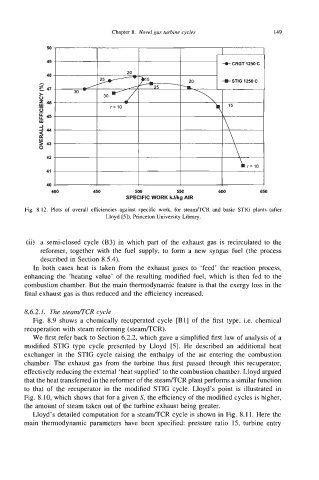
        Fig. 8.10, which shows that for a given S, the efficiency of the modified cycles is higher,
        the amount of steam taken out of the turbine exhaust being greater.
          Lloyd’s detailed computation for a steam/TCR cycle is shown in Fig. 8. I 1.  Here the
        main  thermodynamic parameters have been  specified: pressure ratio  15, turbine entry

